
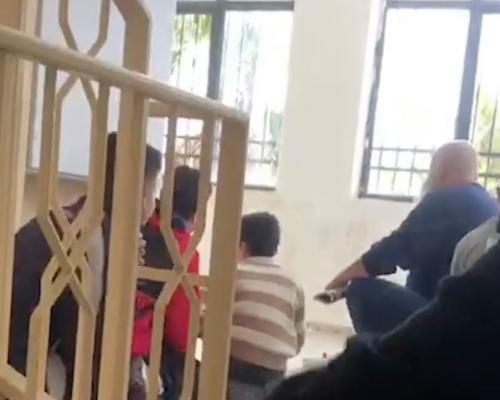
In a tragic incident on April 21, 2023, 14-year-old Aws al-Naasan was shot in the head by an Israeli reservist just outside the Mughayyir boys' secondary school in the occupied West Bank. Aws, a ninth grader, collapsed instantly, bleeding profusely as his friends rushed to his side, marking their path with his blood. Amidst the chaos, terrified students and teachers inside the school were seen crouching in stairwells, desperately trying to shield themselves from the violence.
Footage captured the shooter, dressed in partial military uniform, taking aim from a nearby hillside. Shortly after Aws was shot, the same reservist killed Jihad Abu Naim, the younger brother of an English teacher at the school. Jihad, 36, was set to become a father, with his wife due to give birth to their first child this month. These killings are part of a growing wave of settler violence targeting schools and students in the region. Originally reported by The Guardian.
Long History of Violence in Mughayyir
Mughayyir, a small village with around 3,000 residents located northeast of Ramallah, has faced ongoing violence for years. Aws's father, Hamdi al-Naasan, was shot in the back by a settler in January 2019 while attempting to aid an injured neighbor. At the time, Aws was only in third grade, and teachers devoted special attention to support him as he coped with the loss of his father. Waheed Abu Naim, an English teacher at the school, recounted, "We tried to make Aws feel safe, and ensure he had some rules in his life, to protect him from the impact of losing his father. Then we lost him."
Following the killings, Mughayyir schools suspended classes for a week, forcing parents and educators to grapple with the stark reality of their children's safety. "We want to go back to school, but our families are worried," said Ahmed Abu Ali, a friend of Aws. The violence has created a pervasive atmosphere of fear, undermining the prospects of education in the region.
Broader Attacks on Palestinian Education
The situation for education in Palestine has become dire, particularly in Gaza, where over 600,000 school-age children are nearing three years without formal in-person education. The United Nations reports that Israeli attacks have killed 792 teachers and 18,639 students in Gaza, with nine out of ten school buildings damaged or destroyed. However, the violence isn't limited to Gaza; schools in the occupied West Bank are increasingly becoming targets.
Hours after Aws was killed, settlers attacked a British- and European-funded school for Palestinian children in a nearby village, demolishing it with bulldozers. This incident highlights the systematic attacks on educational institutions, as seen in Hammamat al-Maleh, where settlers blocked access to a school for children from Umm al-Khair village by placing razor-wire across the road. "This path is not just a road, it is the lifeline that connects our children to their education and to a sense of normal life," resident Tariq Hathaleen stated, emphasizing the implications for their community.
Teachers and Students Under Siege
The recurring violence has left teachers on high alert, particularly as they face threats to their students' safety. On the day Aws was murdered, teachers quickly took action when they spotted armed Israelis approaching the school. They locked the gates and sent alerts to parents, urging them to collect their children. Waheed Abu Naim attempted to communicate with the armed individuals, asking in both English and Arabic why they were there. Only one responded, instructing him to "go back," while raising his weapon, a clear indication of their intent.
James Elder, UNICEF's global spokesperson, emphasized that "these attacks on the education of Palestinian children are not isolated incidents." He pointed out that the impact of such targeted violence extends beyond the classroom, affecting children's home lives and well-being. The presence of Israeli soldiers and checkpoints near schools has also contributed to a climate of fear, distracting students and disrupting their education.
As the cycle of violence continues, the future of education in the occupied territories hangs in the balance. Families are torn between the desire for their children to learn and the harsh reality of living in a conflict zone. The tragic deaths of Aws al-Naasan and Jihad Abu Naim serve as a grim reminder of the urgent need for a resolution to the violence that plagues this region.
Originally reported by The Guardian. View original.