
Authorities worldwide were tracing passengers on Thursday after learning that at least 29 people of 12 nationalities left the MV Hondius before its hantavirus outbreak was confirmed. Three people have died, but the World Health Organization says the incident poses a low public health risk and isn't another Covid crisis.
April 24 Departures Trigger International Search
Oceanwide Expeditions, the Dutch operator, said 29 passengers and the body of the first person to die disembarked at the British territory of Saint Helena on 24 April. The first confirmed hantavirus case wasn't reported until 4 May, leaving a gap before isolation measures were implemented. Originally reported by The Guardian.
The departing group included six US and seven British citizens. All had been contacted, the company said, and most, if not all, were believed to have returned home.
A Spanish passenger aboard told El País that travellers had dispersed to Australia, Taiwan, north America, England and homes in the Netherlands. That dispersal has made tracing their movements an international undertaking.
In Switzerland, a former passenger tested positive and was receiving treatment at a Zurich hospital. Swiss authorities said there was no risk to the public. The New York Times reported that the Centers for Disease Control and Prevention (CDC) was monitoring passengers in Georgia, California and Arizona; none had shown illness.
Isolation and Testing Extend Beyond the Ship
Two passengers back in Britain were self-isolating at home without symptoms, according to the UK Health Security Agency (UKHSA). Its chief scientific officer, Prof Robin May, suggested returning passengers would be asked to isolate for 45 days. He described the risk to people unconnected with the cruise as negligible.
Singapore officials said two residents who had travelled aboard the Hondius were isolated and undergoing tests. A Danish citizen was self-quarantining without symptoms, the Danish Patient Safety Authority said.
But attention also turned to someone who hadn't been aboard. The Dutch health ministry said a woman with symptoms was being tested in an isolated ward at an Amsterdam hospital. A positive result could make her the outbreak's first known infected person who wasn't on the ship.
Contact tracing therefore reaches beyond locating former passengers: health officials are also watching for illness among others potentially connected to them. The Amsterdam woman's infection hadn't been confirmed.
WHO Rejects Pandemic Comparison as Cases Rise
The WHO said five of eight suspected cases linked to the vessel had been confirmed. More may emerge because the Andes virus incubation period can reach six weeks, director-general Tedros Adhanom Ghebreyesus told reporters.
"This is not the start of an epidemic. This is not the start of a pandemic. This is not Covid," said Dr Maria Van Kerkhove, the agency's director for epidemic and pandemic preparedness and prevention.
Hantaviruses occur primarily in rodents but can infect humans, causing flu-like symptoms, pulmonary syndrome and respiratory failure. The Andes hantavirus can pass between people through very close contact, although it's less contagious than Covid. There are no vaccines.
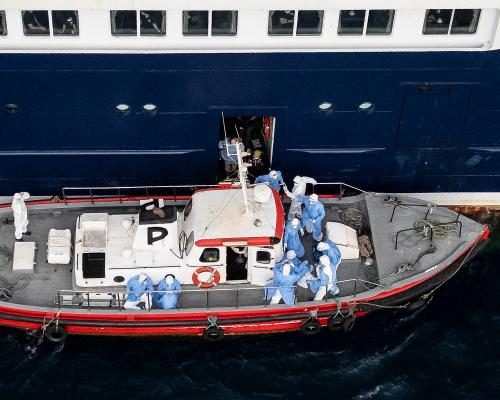
Three symptomatic people medically evacuated from the vessel were being treated in the Netherlands: a 41-year-old doctor, a 65-year-old German passenger and Martin Anstee, 56, a British expedition guide. Their evacuation is separate from the effort to monitor passengers who had already travelled home before confirmation of the outbreak.
Tenerife Prepares Controlled Transfers and Repatriation
With 149 people aboard, the Hondius left waters around Cape Verde, where permission to dock was denied, for Tenerife in Spain's Canary islands. Arrival was expected around midday Sunday.
Archipelago president Fernando Clavijo questioned the central government's decision to receive the vessel and requested a meeting with Spanish prime minister Pedro Sánchez. Spain's health minister, Mónica García, met Clavijo on Thursday and said there was no public health threat.
The ship would remain anchored rather than dock, García said. Its stay would be limited to health and logistical requirements. Passengers would undergo onboard assessments, leaving only for transfer or repatriation with protective equipment and a designated health worker, without contact with residents.
EU nations were expected to start evacuating citizens from Monday 11 May. The 14 Spanish nationals aboard, including one crew member, were to be transferred from Tenerife to the Gómez Ulla military hospital as authorities continued monitoring for further infections.
Originally reported by The Guardian. View original.