
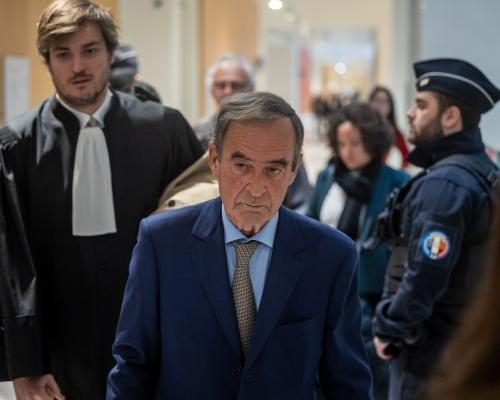
A French court has imposed a fine exceeding €1 million (£870,000) on Lafarge, the cement giant, for its involvement in financing terrorist organizations during the Syrian civil war. The ruling also resulted in a six-year prison sentence for the company's former CEO, Bruno Lafont, who was found guilty of paying protection money to groups like Islamic State and Jabhat al-Nusra to keep its operations running in Syria from 2013 to 2014.
This verdict adds to the company's legal troubles, following a 2022 plea in the United States where Lafarge admitted to conspiring to support US-designated terrorist organizations. The firm agreed to pay a staggering $778 million (£580 million) in fines, marking a historic moment as it was the first time a corporation faced charges for such acts. Originally reported by The Guardian.
Details of the Court Ruling
The Paris court determined that Lafarge, now part of the Swiss conglomerate Holcim, funneled nearly €5.6 million through its subsidiary, Lafarge Cement Syria (LCS). This money was directed towards intermediaries and terrorist groups to ensure the factory's continued operation amid the chaos of the Syrian civil war. Judge Isabelle Prevost-Desprez stated that Lafarge's financial dealings with Islamic State were essential for the organization to maintain control over Syria's natural resources, which in turn facilitated the financing of terrorist activities both in the region and beyond, particularly in Europe.
Bruno Lafont, who led the company during these transactions, received an immediate six-year prison sentence for his role in financing terrorism. His legal representation announced their intention to appeal the verdict. Judge Prevost-Desprez further emphasized the gravity of the offenses, noting that Lafarge had established a "genuine commercial partnership with IS," which exacerbated the severity of their actions.
Context of Lafarge's Operations in Syria
Lafarge constructed a $680 million factory in Jalabiya, Syria, which was completed in 2010, just prior to the outbreak of the civil war in March 2011. While many multinational firms exited the Syrian market in 2012 due to escalating violence, Lafarge chose to retain its Syrian workforce. It only evacuated expatriate staff and continued its operations until September 2014, when IS seized control of the factory.
During the tumultuous years of 2013 and 2014, Lafarge's subsidiary engaged in payments to intermediaries for access to essential raw materials and to secure safe passage for its trucks and employees. This included payments to various armed groups, notably Islamic State and Jabhat al-Nusra. The investigation highlighted the lengths to which the company went to maintain its business interests amid rampant violence and instability.
Reactions and Implications of the Verdict
Organizations advocating for corporate accountability, such as Sherpa and the European Center for Constitutional and Human Rights, welcomed the ruling as a pivotal moment in the fight against corporate complicity in human rights violations. However, they expressed concern that many former Syrian employees of Lafarge are still awaiting compensation for their experiences during the conflict.
Former employees recounted harrowing accounts of living under constant threat, facing bombings, kidnappings, and extreme risks while working for Lafarge. They stated, "Lafarge was aware of what was happening to us - the checkpoints, the threats, the daily fear - but chose to risk the lives of its employees for profit." The former workers are determined to seek justice and compensation for the hardships they endured while working under Lafarge's operations in Syria.
Holcim, which acquired Lafarge in 2015, has maintained that it was unaware of the company's dealings in Syria. The French national counter-terrorism prosecutor's office concluded that Lafarge's actions were driven by a singular aim: profit.
Additionally, Lafarge remains under investigation in France for potential complicity in crimes against humanity, highlighting the continuing legal and ethical scrutiny facing the company.
Originally reported by The Guardian. View original.