
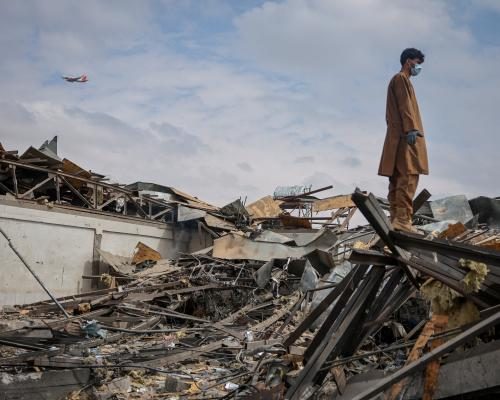
In a devastating airstrike on a drug rehabilitation center in Kabul, over 400 individuals lost their lives, marking one of the deadliest attacks in the ongoing conflict between Afghanistan and Pakistan. Witnesses recounted horrific scenes as Afghan rescue teams continued to search for survivors amid the rubble.
Eyewitness Accounts Reveal Horror
Survivors of the attack described a nightmarish scene unfolding at the state-run Omid hospital when the bombs fell late Monday evening. Haji Fahim, an ambulance driver, vividly recounted his arrival at the hospital: "Everything was burning, people were burning." He returned to the site the following morning, compelled by the grim task of retrieving bodies still trapped under debris. Rescue operations were ongoing, revealing the extent of the tragedy as Afghan crews sifted through the wreckage. Originally reported by The Guardian.
According to Afghan interior ministry spokesperson Abdul Mateen Qanie, the assault claimed the lives of 408 people and injured 265 more. Eyewitnesses confirmed a mass casualty event, with bodies strewn across the compound. While some parts of the facility remained intact, much of it was reduced to charred rubble, leaving bunk beds exposed and personal belongings scattered. Patients dressed in green uniforms, many of whom had shaved heads, were seen sitting in shock in the hospital yard.
Survivors Share Their Stories
Yousaf Rahim, a patient who endured the attack, recalled the chaos that erupted as the explosion occurred. "Everyone was inside the wards when the explosion happened. My bed was in the corner, and I suffered injuries to my leg and thigh. It was a horrific scene. Patients fell from their beds, screaming and running as fire and smoke filled the wards and rooms," he said, describing the suffocating dust and smoke that engulfed the hospital.
Another survivor, Mohammad Mian, who works in the radiology department, noted that many young individuals in treatment lived in containers on the hospital grounds, and very few survived the direct impact of the strike. "It was extremely terrifying. Those who survived were the ones whose rooms were not destroyed and were fortunate. But the places where the bombs were dropped, everyone there was killed," he stated, capturing the grim reality of the situation.
Escalating Violence Amid Political Tensions
This airstrike represents a significant escalation in the ongoing conflict, which has intensified since February when Pakistan initiated airstrikes targeting militant groups in Afghanistan. Despite the severity of the attack, international attention remains fixated on other global crises, notably the rising tensions in the Middle East.
Pakistan has denied allegations of intentionally targeting the rehabilitation center, asserting that the airstrikes were aimed at specific militant infrastructure and arms facilities within Kabul. Information Minister Attaullah Tarar emphasized on social media that the strikes were executed with precision against facilities supporting the Afghan Taliban's various terror proxies.
Omid Stanikzai, a security guard at the drug treatment center, described hearing the jet patrol and subsequent gunfire from Afghan forces before bombs were dropped. He vividly recalled how a fire erupted following the strike, leading to widespread panic and chaos.
International Reactions and Condemnations
The attack has drawn condemnation from various parties, including India, which has criticized the strike on the hospital. As an emerging player in the region, India has established closer ties with the Taliban since the group regained control of Afghanistan in 2021. Additionally, China has urged both nations to exercise restraint and de-escalate tensions.
Richard Bennett, the UN special rapporteur on human rights in Afghanistan, expressed his dismay at the reports of civilian casualties resulting from the airstrikes. He called on all parties involved to adhere to international law, particularly regarding the protection of civilians and critical infrastructure such as hospitals.
The airstrike occurred just hours after Afghan officials reported cross-border exchanges of fire, resulting in casualties, including children. Pakistan characterized its conflict with Afghanistan as an "open war," following a series of cross-border attacks that disrupted a previously brokered ceasefire.
As the situation remains volatile, the humanitarian implications of this attack are profound. The rehabilitation center, known as Ibn Sina drug addiction Treatment hospital, was established in 2016 on the site of a former NATO base, providing essential services and vocational training to hundreds of individuals struggling with addiction. With the loss of life from this attack, the future of such vital services hangs in the balance.
Originally reported by The Guardian. View original.