
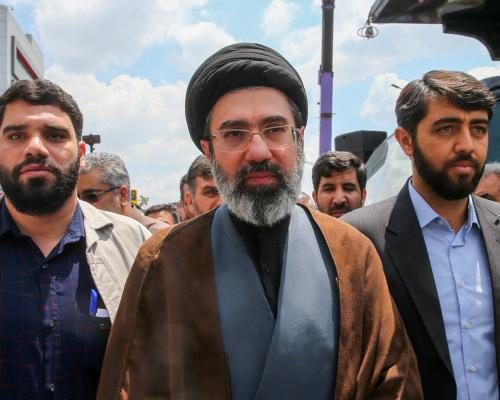
The recent elevation of Mojtaba Khamenei as Iran's New Supreme Leader has raised eyebrows, particularly after reports confirmed he was injured during the initial wave of Israeli Attacks. This development highlights the Islamic Revolutionary Guards Corps' (IRGC) determination to maintain control and their belief that Iran's wartime machinery can function almost seamlessly, even in Khamenei's absence. As details about the severity of his injuries remain scarce, the political implications of his elevation are becoming increasingly significant.
Severity of Injuries Remains Unclear
Mojtaba Khamenei, who ascended to the position of supreme leader amidst chaos, reportedly suffered a broken leg and facial injuries in the Israeli bombing. However, the full extent of his injuries and the pace of his recovery remain ambiguous. Ali Larijani, secretary of the Supreme National Security Council, provided a vague assurance, stating, "his condition has not been reported as critical." This careful wording hints at a lack of direct observation of Khamenei's status, raising questions about the credibility of the information being released. Originally reported by The Guardian.
Despite the turmoil following the attacks, Larijani insisted that Khamenei continues to exercise authoritative guidance and oversight over military operations. He asserted that all actions taken by the IRGC would be executed under Khamenei's direct orders. This claim, however, may be more about maintaining a facade of stability than reflecting the actual state of leadership within Iran.
Suspicion Surrounds His Election
The circumstances surrounding Khamenei's election have sparked skepticism. Delays in his confirmation were initially attributed to the logistical challenges of convening the 88-member Assembly of Experts in a wartime setting. Yet, there are growing doubts regarding Khamenei's capability and willingness to fulfill the responsibilities of the supreme leader role, especially in light of the catastrophic losses his family endured during the attacks. Reports indicate that his parents, wife, and several relatives were killed, leaving him with both emotional and psychological scars.
Opposition groups based in exile have even suggested that Khamenei is in a coma, receiving secretive medical treatment and possibly unaware of his elevation to the supreme leader position. The lack of a public appearance or any form of communication from Khamenei in the days following his confirmation has only fueled these rumors. Social media speculation has run rampant, with some claiming that the IRGC may have installed a mere figurehead to lead the country.
Government Communications Under Scrutiny
The Iranian government's failure to produce any photographic or video evidence of Khamenei since his elevation has led to wide-ranging speculation. An Iranian journalist pointed out that the leader's absence from public view does not negate his ability to govern. "Iran's leader can lead without appearing in public," he stated, emphasizing the importance of effective management over physical presence.
Nevertheless, the absence of clear communication has left a void that the government has struggled to fill. Even within the heavily censored Iranian media, there have been murmurs of concern regarding Khamenei's health and leadership status. In a recent press briefing, Esmail Baghaei, the spokesperson for Iran's foreign ministry, was evasive when asked about Khamenei's role, only stating, "Those who have to receive the message have received the message." This reticence has not helped quell public unease.
Implications for the Islamic Revolutionary Guards Corps
The IRGC's push to elevate Mojtaba Khamenei, despite his health issues, signals a desperate need to consolidate power. Critics, including some imprisoned political dissidents, have labeled the appointment as a blatant display of the IRGC's influence, characterizing it as a puppet show. Maryam Alemzadeh, an associate professor at St Antony's College, Oxford, argues that the IRGC's structure is intentionally designed to withstand leadership changes. "The resilience has relied on this semi-formal network of IRGC, Basij, and other state services," she noted, highlighting the organization's extensive reach across multiple societal roles.
In this context, the IRGC appears unfazed by the potential loss of its leader, viewing it instead as an opportunity to reinforce its own authority within Iran's political landscape. As the situation unfolds, it will be essential to monitor how Khamenei's health and the IRGC's response shape the country's stability amidst ongoing conflict.
Originally reported by The Guardian. View original.