
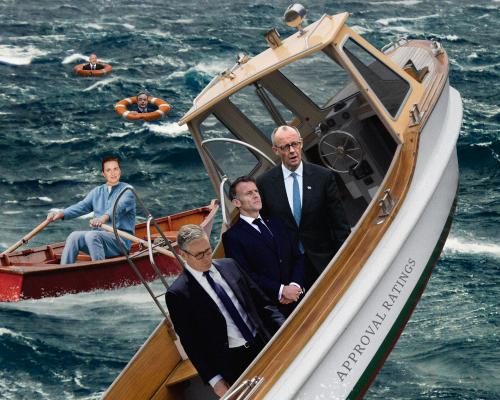
Keir Starmer, Emmanuel Macron, and Friedrich Merz are grappling with alarming levels of unpopularity among their constituents, as recent polling reveals a collective disapproval that could reshape the future of leadership in Europe. Starmer, the UK Prime Minister, has seen only 11% of Britons consider him a good or great leader, while nearly 60% rate him as poor or terrible, according to YouGov data. Macron and Merz are not faring any better, with approval ratings hovering around 18% and 19%, respectively. This widespread dissatisfaction raises questions about the ability of these leaders to navigate their nations through pressing challenges.
Local Election Fallout Highlights Starmer's Struggles
The recent local election results in the UK have cast a shadow over Starmer's leadership. His party's performance has led many within his own ranks to contemplate a leadership change, despite his relatively short tenure. A staggering 65% of the public disapproves of Starmer, with only 27% expressing approval. The stark reality is underscored by an adviser's blunt assessment: "People hate you." This sentiment is echoed in various media, indicating a significant disconnect between Starmer and the electorate. The lack of confidence in his leadership raises concerns about his capacity to challenge the ruling Conservative Party effectively. Originally reported by The Guardian.
Compounding Starmer's issues, a recent think-piece pointed out that almost universally, the public perceives him unfavorably. With a mere 11% of the population viewing him as a competent prime minister, it's clear that his reputation is on shaky ground. Political analysts suggest that his inability to inspire confidence could jeopardize the Labour Party's ambitions in the next general election.
The Contempt for Macron and Merz
Across the channel, President Emmanuel Macron is facing similar challenges. With an approval rating of only 18%, he is perceived as ineffective. His struggles have been exacerbated by losing a parliamentary majority, making it increasingly difficult to implement his agenda. Observers note that Macron's situation is reminiscent of Jacques Chirac's unpopular final term, yet his approval ratings are historically low for a sitting president.
In Germany, Chancellor Friedrich Merz contends with a staggering 19% approval rating. His tenure has been marred by empty promises and a lack of significant reform, leading to widespread discontent. Political expert Peter Matuschek from the polling think tank Forsa points out that Merz's blunders, such as derogatory comments about the US, have further alienated voters. The discontent surrounding these leaders highlights a growing trend of unpopularity across Europe's political landscape.
Europe's Leadership Crisis: A Structural Issue?
The dissatisfaction with political leaders in Europe raises broader questions about the continent's leadership capabilities. Analysts suggest that the issues plaguing Starmer, Macron, and Merz may reflect a more profound structural crisis in European politics. According to World Bank data, Europe's share of global economic output has plummeted from approximately 33% in 2005 to around 23% in 2024, marking the lowest proportion since the Middle Ages.
While the US economy is projected to grow by 2.4% this year, major European economies like Germany and the UK are expected to see growth rates of only 0.6% and 0.9%, respectively. This economic stagnation contributes to the public's dissatisfaction with their leaders. As leaders struggle to respond to economic challenges, many voters express frustration over perceived ineffectiveness.
Comparisons to Global Leaders
The unfavorable ratings of European leaders stand in stark contrast to those of figures like Donald Trump, who, despite significant controversies, maintains a 38% approval rating. Even leaders like Spain's Pedro Sánchez and Italy's Giorgia Meloni, while facing their challenges, have managed to attain slightly better approval numbers than their European counterparts. This disparity raises intriguing questions about the factors contributing to such widespread unpopularity among the leaders of Europe's largest economies.
As Europe grapples with economic, political, and social challenges, the future of its leadership remains uncertain. The disillusionment felt by citizens across the continent may prompt calls for new leadership styles and approaches. This situation underscores the need for leaders who can effectively engage with the electorate and respond to their concerns, potentially reshaping the political landscape for years to come.
Originally reported by The Guardian. View original.