
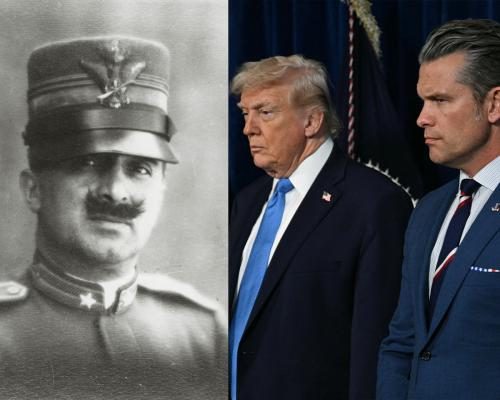
The United States' approach to military strategy in Iran, particularly under the Trump administration, has drawn parallels to historical doctrines of air warfare that date back over a century. The rhetoric from Defense Secretary Pete Hegseth reflects a belief in the overwhelming power of aerial attacks to secure swift victories, reminiscent of theories proposed by Italian General Giulio Douhet in 1921.
Historical Roots of Aerial Warfare
Giulio Douhet's seminal work, The Command of the Air, suggested that future victories would not emerge from the brutal trench warfare of World War I but rather from strategic aerial bombardments. He argued that targeting civilian infrastructure would cripple enemy morale and catalyze uprisings against their governments. Douhet's assertion that destroying supply lines and civilian targets would be more effective than engaging combatants directly laid the groundwork for modern air warfare strategies. Originally reported by The Guardian.
This philosophy informed not just European Conflicts but also shaped the thinking of American military leaders like General Curtis LeMay. Under his command, the U.S. executed extensive bombings in Japan during World War II, including the infamous atomic bombings of Hiroshima and Nagasaki. The belief in aerial dominance continued to influence U.S. military strategies in the Gulf Wars and beyond, as leaders have repeatedly returned to the notion that advanced air power can decisively dictate the outcomes of conflicts.
The Trump Administration's Air Strategy
In recent years, the Trump administration, spearheaded by Defense Secretary Pete Hegseth, has revived these historical notions with a campaign dubbed "Epic Fury" against Iran. Hegseth's rhetoric signals a commitment to unleashing unprecedented aerial assaults, promising the "most lethal and precise air power campaign in history." His language suggests a belief that sheer volume and technological sophistication can ensure success, echoing Douhet's insistence on overwhelming firepower.
Hegseth's declarations about increasing sortie rates and the scale of bombardments hark back to Douhet's idea that "quantity has a quality all its own." As air strikes ramp up, the current administration seems convinced that more bombs will yield quicker victories, a perspective that has historically proven problematic. In previous conflicts, such as the air attacks on Iraq and Serbia, military leaders have often overestimated the effectiveness of such strategies, neglecting to account for the resilience of affected populations.
The Role of Civilian Morale
Central to Douhet's theory was the idea that inflicting damage on civilian morale would lead to revolts against oppressive regimes. He posited that civilians, driven by self-preservation instincts, would demand an end to hostilities once their infrastructure was devastated. While Hegseth has avoided explicitly targeting civilians, his comments suggest an expectation that the Iranian populace might rise against their government under the weight of aerial assaults. He stated, "We are warriors, trained to kill the enemy and break their will.. now is your time," referring to the Iranian people.
Critics, however, argue that such strategies often backfire. Winslow Wheeler, a former Government Accountability Office official, cautioned against the assumption that technology can predict human behavior in warfare. Historical examples, like the German bombings during WWII, illustrate that bombing campaigns can galvanize populations rather than demoralize them. As Wheeler noted, "Think of the German attacks on the British, did that weaken the British resolve? No. It caused the population to unite."
Lessons from Past Conflicts
The Vietnam War serves as a cautionary tale of the pitfalls of relying solely on air power. The United States believed it could effectively neutralize the Ho Chi Minh trail, a critical supply line for North Vietnamese forces, through relentless bombing campaigns and sophisticated technology. However, the tenacity of the North Vietnamese, coupled with their ability to adapt to American tactics, showcased the limitations of aerial assaults.
As military strategies evolve, the historical lessons remain relevant. The notion that aerial bombardment can achieve an easy victory is a seductive but dangerous delusion. The complexities of human nature and the unpredictable responses of populations on the ground remind military strategists that success in warfare requires more than just technological superiority. It demands an understanding of the socio-political landscape and the potential ramifications of air campaigns.
As the U.S. continues its military engagements abroad, the echoes of Douhet's theories remain present. Whether the current administration can break free from the historical patterns of over-reliance on air power is a question that looms large as tensions with Iran escalate. The path ahead must consider not only the power of aerial strikes but also the resilience and reactions of the targeted populations.
Originally reported by The Guardian. View original.