
Colombia's Comuneros del Sur guerrillas are pursuing an unusual route out of war: legal gold mining. The roughly 250 fighters in Nariño have signed 12 partial peace agreements under President Gustavo Petro's Total Peace agenda, but approaching elections, disarmament delays and rival armed groups threaten their proposed transition to civilian livelihoods.
A Breakaway Force Keeps Its Weapons
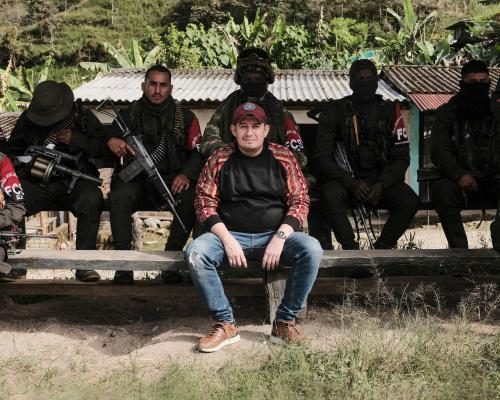
Royer Garzón, the group's commander and a negotiating delegate, presents the initiative beside a concrete sports field in one of Nariño's state-recognised Indigenous collective territories. About two-dozen combatants sit alongside him, most wearing military fatigues and rubber boots. Originally reported by The Guardian.
Garzón wears civilian clothes with Pasto Indigenous motifs across his sleeves. Behind the gathering, a red-and-white FC Sur-ELN - Frente Comuneros del Sur banner preserves the identity of the National Liberation Army organisation they left.
The Comuneros del Sur broke away from the ELN in May 2024, saying its leadership denied them negotiating autonomy. They wanted talks to move faster.
"Our bet for peace is a territorial peace, one where communities play a leading role," Royer Garzón says. But he insists the fighters won't disarm without a comprehensive treaty.
Now in his early 40s, Garzón has spent more than 20 years in the conflict. Soft-spoken and teacher-like, he says he's tired of war and wants to return to civilian life.
Twelve Accords Seek an Alternative to Coca
The agreements cover weapons destruction, coca crop substitution and territorial development, with implementation advancing as individual deals are reached. Legalising mines would give communities and former fighters an income beyond the illicit economies that have sustained conflict.
Most combatants come from Nariño. Their ranks also include a Venezuelan migrant and an Ecuadorian, alongside youths from Indigenous, Afro-Colombian and farming families in areas dominated by coca and gold.
"We represent a territorially based movement, and our guerrilla force is deeply rooted across various sectors and territories of the Nariño department," Royer Garzón says.
Coca can't provide the same route into legal employment, he argues: there's no pathway to legalisation, and prices have fallen sharply amid overproduction and other pressures.
"Coca is no longer profitable," Royer Garzón says. Although cultivation recently reached record levels, farmers remain the cocaine supply chain's poorest, most vulnerable participants. They've also borne decades of counternarcotics crackdowns, including aerial glyphosate spraying. For them, replacing coca requires an income that lasts.
Record Gold Prices Raise the Stakes
Gold mining offers a different proposition, but it's already entangled with armed power. Six armed groups contest Nariño's mineral wealth, taxing miners and fighting over access to resources.
With gold prices reaching record highs above $5,000 (£3,700) an ounce in 2026, the incentives are formidable. Making mining legal won't automatically remove the forces profiting from it.
Production figures expose another obstacle. Nariño officially reported 344kg of gold in 2024 and 196kg last year, in 2025. Departmental government sources, however, estimate monthly production at between 1,000kg and 2,000kg, suggesting the official totals substantially understate extraction.
The department's green mountains also contain manganese, a mineral essential to steelmaking and used in electric-vehicle batteries. Locally, it supplies another market: cocaine processing.
Potassium permanganate, derived from manganese ore, helps transform coca paste into cocaine hydrochloride. A local miner describes processing kitchens or crystallisation laboratories appearing wherever manganese is found. The overlap shows how closely mineral extraction and drug production remain connected.
Elections Test Nariño's Territorial Peace Experiment
Gold's association with violence stretches back to Spanish conquistadors massacring Indigenous populations while seeking mineral-rich territories. In Nariño, converting that resource into a foundation for peace means changing who controls extraction and who receives its proceeds.
The risks are immediate. Armed rivals could move into territory as the Comuneros del Sur relinquish weapons. Yet retaining those weapons while agreements advance leaves the peace process incomplete.
Petro's approaching departure adds political uncertainty. No armed group is expected to complete demobilisation during his term, despite advances in negotiations. For Nariño's communities, continuity will matter as much as signatures.
The test is whether legal gold mining can deliver livelihoods before elections disrupt implementation or rivals seize the opening. Without that transition, mineral wealth could keep financing conflict instead of helping fighters leave it.
Originally reported by The Guardian. View original.