
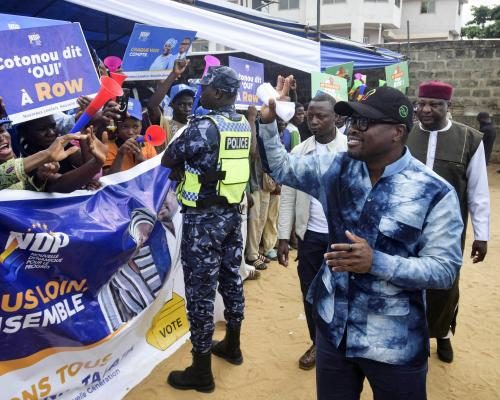
This Sunday, Benin will hold a presidential election just four months after a failed coup attempt, a vote that carries the weight of significant political tension. The current president, Patrice Talon, who has held office since 2016, is not eligible to run again due to term limits. Instead, the spotlight is on Romuald Wadagni, the favored candidate from the ruling coalition, who hopes to build on Talon's legacy. This comprehensive guide covers benin holds presidential election four months after failed coup in detail.
Understanding Benin Holds Presidential Election Four Months After Failed Coup
The upcoming election is marked by a constitutional amendment that allows the winner to serve two seven-year terms, a change seen as controversial. Talon, whose tenure has been characterized by economic reforms and infrastructural development, has faced criticism for his increasingly authoritarian style. Critics argue that he has stifled dissent, leading to heightened tensions that culminated in December's coup attempt. Originally reported by The Guardian.
Wadagni, currently the finance minister and a technocrat, is viewed as the architect of the nation's recent fiscal stability. His rise to the candidacy was marked by a lack of primaries, drawing accusations that the ruling coalition has manipulated the political landscape to eliminate competition. According to Africa Confidential, potential challengers have been either sidelined or eliminated altogether, paving the way for Wadagni's emergence.
Voter Apathy and Electoral Challenges
As the election approaches, concerns about voter turnout are growing. In January, only 36% of the approximately 7.8 million registered voters participated in legislative elections, a situation that could repeat itself this weekend. Many citizens feel disenfranchised by the electoral process, particularly after the parliament raised candidacy thresholds, making it nearly impossible for opposition parties to compete effectively.
The main opposition figure, Paul Hounkpè of the Cowry Forces for an Emerging Benin (FCBE), has been criticized as a token candidate, having cut a deal with the ruling coalition to qualify for the race. Meanwhile, the Democrats, the lead opposition party, chose not to field any candidates, opting instead to abstain from the election process. They cited the disqualification of their candidates as a deliberate exclusion from the political arena, indicating a troubling trend towards a one-party state.
Human Rights Concerns and Press Freedom
Human rights organizations have raised alarms about the shrinking civic space in Benin. Reports indicate a wave of attacks on independent media and arbitrary arrests of dissenters. The arrest of journalist Hugues Sossoukpè, who was taken into custody in Ivory Coast after being labeled a "dangerous cyberactivist," exemplifies the government's crackdown on free expression. Amnesty International's Dieudonné Dagbéto emphasized that "civic space continues to shrink in Benin with a wave of attacks on independent media outlets and people still being arbitrarily arrested and detained for dissent."
Moreover, women and marginalized groups continue to face discrimination, with forced evictions further jeopardizing the rights of thousands. The government's approach to dissent and criticism poses a significant challenge to the democratic process, stirring fears among the populace about the upcoming election's legitimacy.
Wadagni's Promises and Future Prospects
If elected, Wadagni plans to introduce initiatives aimed at improving education and creating more jobs, particularly vital in a nation where over half the population is under 25. His ability to communicate in English, a skill honed during his time as a technocrat in the United States, positions him uniquely to engage with international stakeholders.
However, his ascension may also be seen as a continuation of Talon's legacy rather than a fresh start for Benin. As the nation navigates these turbulent waters, the outcome of this election will not only shape the political landscape but also influence regional dynamics, especially as neighboring countries grapple with military governance.
Ultimately, Benin stands at a crossroads. The forthcoming election represents an opportunity to break away from the trend of military rule that has gripped parts of West Africa. Yet, the political maneuvering and suppression of dissent raise critical questions about the integrity of the electoral process and the future of democracy in Benin.
Originally reported by The Guardian. View original.