
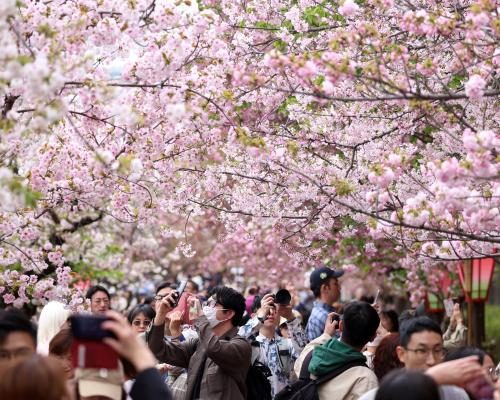
Cherry blossom season in Japan holds deep cultural significance, and the meticulous observations of Prof. Yasuyuki Aono have provided valuable insights into climate change over the past 1,200 years. Aono, who passed away on August 5, 2022, dedicated his life to documenting the peak flowering dates of the mountain cherry (Prunus jamasakura), using historical records dating back to the 9th century. His research revealed a concerning trend: cherry trees have been blooming earlier in the year, an indicator of climate shifts affecting ecosystems.
Aono's Passion for Cherry Blossoms
Throughout his career at Osaka Metropolitan University, Aono passionately tracked the flowering dates of cherry trees, gathering data that is among the longest-running climate records globally. In his final months, he eagerly anticipated the arrival of spring blossoms, sharing updates on social media until his death. Last April, he documented the peak bloom for 2025 as April 4, but he left the 2026 entry blank, a poignant reminder of his commitment to continuing this essential research. Originally reported by The Guardian.
Following Aono's passing, his colleagues, including Tuna Acisu from Our World in Data, feared for the future of this valuable dataset. Acisu noted that Aono's meticulous work was crucial for understanding climate change impacts, making the continuity of his observations particularly vital. "You can very much see that he planned to continue," Acisu reflected, recalling Aono's dedication.
Search for a Successor
Recognizing the importance of Aono's research, Acisu initiated a search for a successor capable of carrying on his legacy. The goal was to find a researcher who could continue monitoring the mountain cherry's peak flowering dates in the same location: Arashiyama, Kyoto. Unlike other cherry blossom monitoring projects in Japan, which often focus on different species, Aono's long-term data specific to the mountain cherry is unparalleled.
After reaching out to various contacts, Acisu received numerous messages of support and interest. Eventually, a researcher in Japan stepped forward, expressing a willingness to continue Aono's observations. Although the new researcher requested anonymity until arrangements are finalized, Acisu confirmed that they are using Aono's original sources to provide this year's flowering data.
The Significance of Aono's Findings
Aono's work has had a profound impact on climate science, highlighting the connections between cherry blossom blooming patterns and broader climate trends. His research indicated that the peak flowering dates for mountain cherry trees have shifted significantly over the years, with the earliest blooms recorded in 2021 and 2023, occurring on the 85th and 84th days of those respective years. Such findings have made Aono's dataset invaluable for scientists studying climate change.
Experts like Toshio Katsuki, a dendrologist at the Forestry and Forest Products Research Institute, emphasized the academic importance of continuing the records Aono established. He noted that preserving the timeline of flowering dates is vital for understanding ecological shifts in response to climate warming.
A Legacy of Dedication
Richard Primack, a biology professor at Boston University, remembered Aono fondly during a visit to Japan in 2006. He described Aono's dedication to his work, stating that Aono even learned to read old forms of Japanese to access historical records that informed his research. Through dusty archives, Aono uncovered references to cherry blossom festivals, allowing him to reconstruct flowering timelines that spanned over a millennium.
In a recent paper, Primack and Katsuki highlighted how climate change also affects other cherry species, such as the Somei-yoshino cherry (Prunus x yedoensis). Their findings suggested that warmer winters lead to diminished flowering displays, impacting the aesthetic quality of cherry blossoms traditionally celebrated across Japan.
As spring approaches, the cherry blossoms will bloom once again, and the legacy of Prof. Yasuyuki Aono will continue through the efforts of new researchers. This continuity not only honors Aono's life work but also serves as a vital resource for understanding how climate change affects one of Japan's most beloved natural phenomena.
Originally reported by The Guardian. View original.