
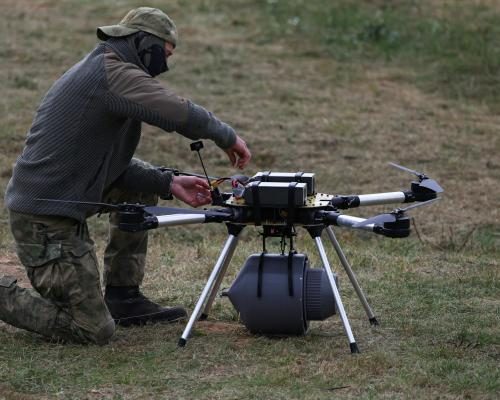
Ukrainian President Volodymyr Zelenskyy announced on Monday that Russia is establishing four control stations for long-range attack drones in Belarus. This development raises concerns about Belarus's increasing involvement in the ongoing conflict, prompting Zelenskyy to declare, "There will be responses to this. And they will be felt." With the war escalating, this move signals a potential shift in strategies for both Russia and Ukraine.
Growing Risks of Belarusian Involvement
In his recent comments on social media platform X, Zelenskyy highlighted the growing threat posed by Belarus in the context of the Ukraine war. He has consistently warned that Belarus could become more deeply entwined in Russia's military operations. The president specified that he had instructed the head of Ukraine's military intelligence to inform international partners about Russia's plans, emphasizing the need for a coordinated response. Originally reported by The Guardian.
Reflecting on the earlier phases of the conflict, Zelenskyy said that Belarusian support had intensified the impact of Russian assaults until Ukraine took countermeasures. "We now have information from our intelligence that Russia intends to continue using the territory of Belarus and temporarily occupied territory of Ukraine to build ground control stations for long-range drones," he stated. This revelation underscores the strategic significance of Belarus in Russia's military calculus, raising alarms in Kyiv and beyond.
Concerns Over EU-Russia Relations
Meanwhile, tensions are also simmering within the European Union regarding Hungary's relations with Russia. Reports surfaced that Hungary's Foreign Minister Peter Szijjarto had been sharing sensitive information from EU meetings with Russian officials, particularly his counterpart Sergei Lavrov. This has drawn ire from EU officials, who demand transparency in relations among member states.
On Monday, European Commission spokesperson Anitta Hipper emphasized the importance of trust among EU nations, stating, "A relationship of trust between member states and between them and the institution is fundamental for the work of the EU." Hungarian Prime Minister Viktor Orbán, who has maintained a close relationship with Russia, faces scrutiny as the EU deals with the fallout from these revelations. Szijjarto labeled the reports as "fake news," while Hungary's Minister for European Affairs, Janos Boka, defended the communication between the foreign ministers.
U.S. Intelligence Sharing with Iran
In a related development, President Zelenskyy announced that Ukraine's military intelligence possesses "irrefutable" evidence of Russia's ongoing intelligence cooperation with Iran. This collaboration, according to Zelenskyy, could exacerbate tensions In The Middle East and prolong existing conflicts. "Russia is using its own signals intelligence and electronic intelligence capabilities, as well as part of the data obtained through cooperation with partners in the Middle East," he asserted on X.
He warned that the consequences of such actions are dire, contributing to instability in the region. "This is clearly destructive activity and must be stopped as it only leads to further destabilisation," Zelenskyy stated. The Kremlin, however, dismissed a Wall Street Journal report claiming that Russia was sharing satellite imagery and advanced drone technology with Iran, labeling it as "fake news."
U.S. Commitment to Ukraine's Reconstruction
Amid these escalating tensions, U.S. officials traveled to Kyiv to discuss the U.S.-Ukraine Reconstruction Investment Fund, which aims to mobilize investments in critical sectors following the devastation caused by the war. Established as part of a minerals deal signed in April, the fund is expected to reach $200 million by the year's end, with Ukrainian officials anticipating the announcement of three initial investment projects this year.
"We are working hard to bring the first deal to the investment committee for approval. For the moment we think that it is on track to happen," a Ukrainian official stated. The fund focuses on critical minerals, hydrocarbon extraction, and dual-use technologies, which are vital for Ukraine's recovery and future resilience.
As the war continues to inflict a heavy toll on civilians, with United Nations reports estimating 15,364 civilian deaths, including 775 children, the urgency for a resolution becomes more pronounced. U.S. Undersecretary of State Christopher Landau reiterated the commitment to work with both Russia and Ukraine to seek a diplomatic solution, urging both sides to engage in meaningful negotiations.
Originally reported by The Guardian. View original.