
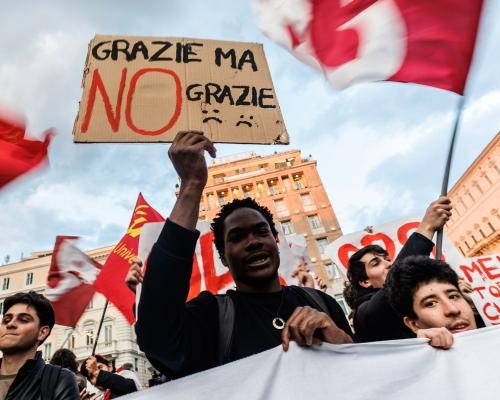
In a surprising turn of events, young Italian voters have emerged as a potent political force, shaking the stability of Giorgia Meloni's far-right government following a recent failed referendum. The plebiscite, which sought to implement significant changes to Italy's judicial system, saw a remarkable 68.4% of voters aged 18 to 29 opposing the proposed reforms, reflecting a growing political engagement among younger generations.
Filippo Michelini, a 29-year-old computer scientist currently residing in Brussels, captured the essence of this shift during a night out at San Calisto, a well-frequented bar in Rome's Trastevere neighborhood. He returned to Italy specifically to cast his vote. "The constitution is a fundamental element of our society," he stated, emphasizing his concerns about the proposed changes that aimed to alter Italy's post-fascist constitution. Critics of the reforms argued they would disproportionately empower the government, while Meloni claimed they were essential for ensuring judicial impartiality. Originally reported by The Guardian.
Younger Voters Defy Apathy Stereotype
Historically, young voters in Italy have been viewed as politically apathetic, often disengaged from traditional electoral processes. However, the recent referendum demonstrated a significant mobilization. Despite logistical challenges-such as the inability to vote by proxy or post for students and workers living away from their registered hometowns-young Italians made their voices heard. Michelini noted that many, like himself, felt compelled to return home to participate in the vote, highlighting the issue's importance. His friend, who preferred to remain anonymous, echoed similar sentiments, stating, "If this was a government I trusted, I might have voted in favour, but from what I could understand, it was not about improving the system."
The proposed judicial changes aimed to restructure Italy's judiciary, raising alarms about potential government overreach. The referendum's outcome not only underscored a decisive stand against Meloni's plans but also illustrated a broader trend of increasing political engagement among youth, particularly on issues like climate change and civil rights.
Political Fallout for Meloni's Government
The referendum's failure has sent shockwaves through Meloni's administration, which had previously enjoyed a period of relative stability. In the aftermath of the vote, Daniela Santanchè, the tourism minister and a member of Meloni's Brothers of Italy party, resigned amid ongoing legal concerns regarding her business dealings. This resignation marks a significant turn in a government that has seen other officials step down due to their connections with controversial figures, including individuals linked to organized crime.
Political analysts are closely watching the implications of these developments. Cecilia Sottilotta, an associate professor of politics at the University for Foreigners in Perugia, remarked, "The resignations show how shrewd Meloni can be. She's kicking the others out in order to avoid bringing the focus on herself and Nordio." This strategy appears to be a calculated move to deflect criticism and maintain her grip on power.
Coalition Partners in Turmoil
The repercussions of the failed referendum are not confined to Meloni's party. Forza Italia, her coalition partner, is experiencing its own internal strife. The party had supported the judicial reforms in honor of its late founder, Silvio Berlusconi, who himself faced numerous criminal trials. Reports indicate that party leader Antonio Tajani may be facing pressures to resign as his party grapples with demands for renewal and change.
Meanwhile, Matteo Salvini, leader of the League and another key ally, has sought refuge abroad, meeting with far-right leaders in Hungary. His attempt to bolster international support reflects an awareness of the shifting political landscape at home as Meloni's government faces increasing scrutiny.
Growing Pressure for Change
Despite Meloni's outward composure, pressure is mounting from various fronts. As she flew to Algeria to negotiate gas supply agreements, calls for her resignation are growing louder. On Saturday, large crowds are expected to march in Rome, demanding not only an end to ongoing conflicts but also accountability from the government. The high turnout among young voters in the referendum signals a potential shift in the political dynamics of Italy, as issues such as civil rights, job security, and climate action continue to resonate with this demographic.
This referendum marks a critical juncture for Meloni's government, indicating that young Italians are no longer willing to sit on the sidelines. The outcome may force a reevaluation of political strategies and priorities, as the youth's demands for transparency and accountability become increasingly difficult to ignore.
Originally reported by The Guardian. View original.