
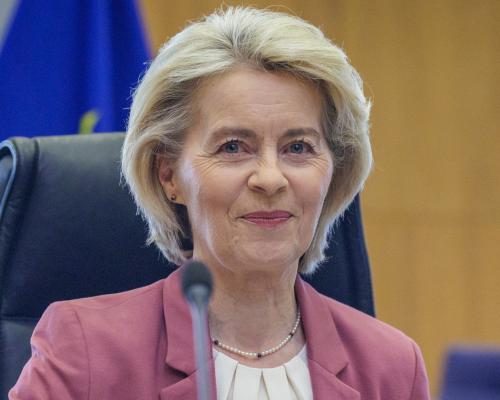
Ursula von der Leyen, President of the European Commission, called for a fundamental shift in the European Union's foreign policy during a speech to EU ambassadors on Monday. She asserted that Europe can no longer act as a custodian of the old-world order, emphasizing the need for a more realistic and interest-driven approach to international relations.
Shifting Paradigms in EU Foreign Policy
In her remarks, von der Leyen highlighted the urgency of reevaluating the EU's existing doctrines and institutions, originally designed in a postwar era characterized by stability and multilateralism. "We urgently need to reflect on whether our doctrine, our institutions, and our decision-making - all designed in a postwar world of stability and multilateralism - have kept pace with the speed of change around us," she stated. The President's assertions come amid growing geopolitical tensions and a rapidly changing global landscape, prompting a call to rethink strategies that have long guided European diplomacy. Originally reported by The Guardian.
The EU, while committed to defending the rules-based international order, can no longer depend solely on this framework to protect its interests. Von der Leyen's comments underline a significant pivot towards a more pragmatic approach, aiming to ensure that the union can effectively respond to contemporary threats and challenges.
Criticism and the Iran Conflict
Von der Leyen's call for a revised foreign policy comes in the wake of criticism regarding her handling of the ongoing conflict in Iran. Recently, Nathalie Loiseau, a prominent Member of the European Parliament and former French minister, criticized von der Leyen for her direct telephone diplomacy with Gulf leaders, which some perceived as undermining the role of EU foreign policy chief, Kaja Kallas. Von der Leyen's statements, particularly her earlier assertion that a "credible transition in Iran" was urgently needed, have drawn scrutiny for appearing to overstep her authority.
While addressing the EU ambassadors, von der Leyen refrained from assigning blame to the United States or Israel for initiating the conflict, instead suggesting that the debate about whether the war was a "war of choice or a war of necessity" was somewhat misplaced. She remarked, "No one would shed tears for a regime that had 'slaughtered 17,000 young people,'" referencing the Iranian government's crackdown on dissenters.
Humanitarian Concerns and Regional Stability
The EU's response to the humanitarian fallout of the Iran conflict was also a focal point of von der Leyen's speech. She announced plans to provide humanitarian aid for 130,000 people in Lebanon, where the repercussions of the conflict have left half a million individuals homeless due to recent Israeli bombings and evacuation orders. Von der Leyen expressed deep concern over the broader regional implications of the escalating violence, stating that the conflict is leading to instability with "unintended consequences" affecting areas such as energy, finance, and trade.
During a separate video conference, von der Leyen and European Council President António Costa engaged with leaders from Middle Eastern nations, including Armenia, Egypt, Iraq, and Saudi Arabia, to discuss the crisis. This meeting was characterized as a demonstration of solidarity among nations facing the fallout of the conflict, emphasizing the EU's commitment to regional stability and cooperation.
Enhancing Maritime Security Operations
In light of the ongoing conflict, von der Leyen and Costa also expressed a willingness to bolster maritime defensive operations in the Red Sea region. These operations, known as Aspides and Atalanta, are designed to protect vital waterways and ensure the security of supply chains. Aspides was initiated in 2024 following attacks on international shipping by Houthi rebels, while Atalanta was established in 2008 to counter Somali piracy in the Horn of Africa. The extension of Atalanta's mandate indicates the EU's proactive approach to safeguarding maritime routes crucial for global trade.
As the EU grapples with an increasingly complex geopolitical landscape, von der Leyen's calls for a more pragmatic and interest-focused foreign policy could signal a turning point in how Europe navigates its role on the world stage. The confluence of humanitarian concerns, regional stability, and security operations illustrates the multifaceted approach the EU is now undertaking in response to emerging global challenges.
Originally reported by The Guardian. View original.