
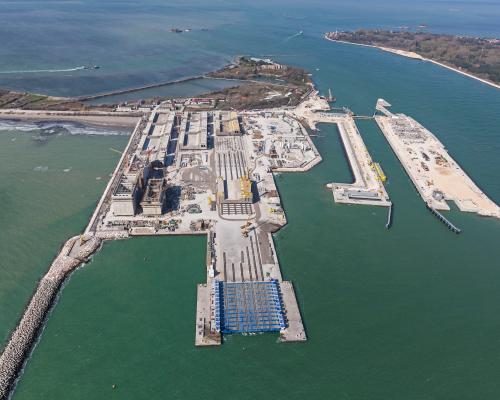
Venice is already strategizing a backup plan for its flood defense system, Mose, just five years after its launch. Rising sea levels due to climate change compel authorities to seek solutions as the city's ecosystem faces imminent threats. With climate projections forecasting a potential rise of an additional meter in sea levels by the end of the century, the urgency for action has never been more critical.
Historic Arsenale: The Heart of Venice's Flood Defense
The Arsenale, a grand shipyard that played a pivotal role in the Venetian Republic's maritime supremacy for seven centuries, serves as the operational hub for the Mose flood defense system. This vast complex, renowned for its 16th-century assembly line capable of producing a warship daily, now houses the control center that oversees the Mose project. Named after the biblical figure Moses, who parted the seas, the system comprises massive barriers deployed at three inlets between the lagoon and the Adriatic Sea. Since its inauguration in 2020, Mose has successfully prevented flooding in Venice on 154 occasions. Originally reported by The Guardian.
However, despite its apparent success, city officials express concern over the rising frequency at which the barriers must be activated. The ongoing climate crisis has forced engineers to deploy the Mose barriers more often, which could have detrimental effects on the lagoon's ecosystem.
Environmental Concerns Loom Over Flood Barriers
Andrea Rinaldo, the head of the scientific committee for the newly established Lagoon Authority, warns that the current operational strategy of the Mose is unsustainable. He stated, "With a metre more, you would have to close the Mose barriers on average 200 times a year, which means it's practically always closed." This frequent closure compromises the lagoon's natural flow, turning it into a stagnant body of water.
The natural tides between the lagoon and the Adriatic create essential exchanges of water and sediment. However, the elevated barriers disrupt this flow, leading to an excess growth of algae. When the algae die, they decompose and deplete oxygen from the water, endangering marine life. Rinaldo emphasizes the need for immediate action, stating, "You won't have a lagoon. You won't have a city. And all of this could happen in a timeframe that is comparable with the time that we had to design and build the Mose. We can't wait."
Mose's Complex History and Operation
The journey to implement the Mose flood defense system was fraught with challenges. Initially conceived after Venice experienced its most catastrophic flood on November 4, 1966, the project took five decades to materialize. Delays were caused by bureaucratic red tape and concerns about environmental impacts. The arrest of former Mayor Giorgio Orsoni in 2014 for corruption further complicated matters, revealing a network of cronyism that inflated the project's costs significantly.
Despite initial skepticism from residents regarding the system's effectiveness and its financial implications, the Mose has proven its worth since its implementation, keeping the city dry. Inside the operations center at the Arsenale, the atmosphere resembles a high-tech command center, where meteorological data is continuously monitored. Giovanni Zarotti, the technical director of Mose, highlighted the careful calculations involved in barrier deployment, noting that decisions are made three hours before expected flooding. "We're relying on God, statistically speaking," he quipped, underscoring the inherent uncertainties involved.
Financial Implications of Flood Management
Activating the flood barriers incurs significant costs, with each closure priced at approximately €200,000 (£175,000). This financial burden becomes particularly evident during high-traffic events like the Venice Carnival, where the barriers were deployed 26 times over three weeks, costing the city more than €5 million. To mitigate economic impacts, the team is experimenting with staggered barrier closures to lessen disruptions to maritime traffic, especially through the Malamocco inlet.
As Venice grapples with the dual challenges of climate change and economic viability, the call for a contingency plan grows louder. The Lagoon Authority is tasked with considering what could replace or complement the Mose system, raising the stakes for the future of this iconic city.
With the alarming forecasts surrounding sea-level rise, Venice's fate hangs in the balance. The city cannot afford complacency; steps must be taken swiftly to ensure its survival amid the rising waters.
Originally reported by The Guardian. View original.