
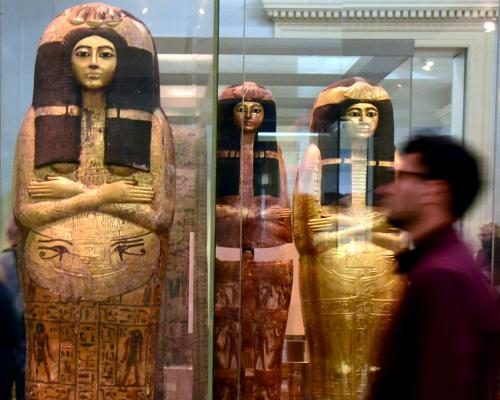
The extensive collection of overseas human remains in UK museums has sparked outrage among MPs and archaeologists, who label it a troubling remnant of colonialism. An investigation revealed that more than 263,000 items, including mummies, skulls, and bones, are housed in UK institutions, with many stored in ways deemed sacrilegious.
Responses to freedom of information requests by the Guardian have highlighted that approximately 37,000 of these human remains are confirmed to come from abroad, predominantly from former British colonies. An additional 16,000 items have uncertain origins. Specifically, out of 28,914 items known to be from outside Europe, 11,856 are traced back to Africa, 9,550 to Asia, 3,252 to Oceania, 2,276 to North America, and 1,980 to South America, showcasing a global impact of colonial acquisition. Originally reported by The Guardian.
Colonial Legacy Under Scrutiny
The investigation revealed that the Natural History Museum in London holds the largest collection of non-European human remains, totaling at least 11,215 items, with significant numbers originating from Asia and both North and South America. Following closely is the University of Cambridge, which has at least 8,740 items in its Duckworth laboratory, including a notable collection of 6,223 remains from Africa.
The report from the Guardian indicates that only 100 out of 241 museums, universities, and councils that possess human remains provided a clear count of individuals represented. This totals around 79,334 people, while many institutions remain unaware of the exact number due to mixed remains or inadequate record-keeping. Some even report possession of cardboard boxes containing human remains, with no knowledge of their origins.
Calls for Ethical Reform
Lord Paul Boateng, a prominent figure in this debate, condemned the findings, asserting that they expose UK museums and universities as "imperial charnel houses." He emphasized that these institutions continue to retain the remains of Indigenous peoples taken from the former British Empire without regard for their cultural significance. Boateng described the retention of these remains as "frankly sacrilegious and deeply spiritually offensive," urging the Department for Culture, Media and Sport (DCMS) to establish a national register of human remains and implement guidelines for their return to countries of origin.
Bell Ribeiro-Addy, MP and chair of the all-party parliamentary group for Afrikan reparations, echoed this sentiment, labeling the warehousing of looted remains as barbaric. She criticized the lack of records and respect for the deceased, stating, "That our country allowed such a large collection of human remains to be taken from other places and keep no record of them points to some sort of crime." Ribeiro-Addy added that the manner in which these remains are kept denies them dignity, even in death, which is a disgrace to the nation.
Contradicting Previous Claims on Human Remains
Experts argue that the findings contradict earlier claims made by the DCMS in its 2005 guidance, which stated that most human remains in UK museums originated domestically and were excavated under uncontentious conditions. Dan Hicks, a professor of contemporary archaeology at the University of Oxford, analyzed the freedom of information responses and noted that many collections contain remains that were looted from cemeteries and battlefields by British colonial officials, often serving as trophies or for pseudoscientific purposes, like eugenics.
Hicks criticized museums for failing to adhere to government guidelines that call for respectful treatment of human remains, including proper storage and public inventory disclosure. He highlighted that the ongoing neglect of these guidelines perpetuates the colonial violence inherent in the acquisition and treatment of human remains, suggesting a need for systemic reform in how institutions handle such sensitive collections.
Institutional Responses and Future Directions
Both the DCMS and the University of Cambridge declined to comment on the investigation's findings. However, the Museums Association acknowledged that a significant portion of human remains in UK collections were acquired during the colonial era. Director Sharon Heal expressed the need for updated guidance and legislation to ensure the ethical treatment of these remains and support the communities from which they originated.
The Natural History Museum, while stating its commitment to high standards of care, has not refused to return remains when connections to communities are established. As discussions around the ethical implications of these collections continue, the spotlight remains on museums to reconsider their roles and responsibilities in addressing this colonial legacy.
Originally reported by The Guardian. View original.