
In a significant law enforcement breakthrough, Sebastián Marset, a notorious Uruguayan drug trafficker known as one of South America's most wanted criminals, was arrested in Bolivia. The 34-year-old is accused of orchestrating a vast cocaine trafficking operation that transported tonnes of the drug from South America to Europe. His capture follows allegations that he ordered the assassination of Paraguayan prosecutor Marcelo Pecci, who was shot and killed while on his honeymoon in Colombia in 2022.
Connection to High-Profile Murder
Marset's criminal activities extend beyond drug trafficking; he is also implicated in the murder of Pecci, a key figure in Paraguay's fight against organized crime. The prosecutor's assassination was a shocking event that drew international attention, with Colombia's President Gustavo Petro attributing the order to Marset. This violent act underscored the dangers faced by law enforcement officials targeting drug networks. Originally reported by The Guardian.
Pecci was killed on the Colombian Caribbean island of Baru, an incident that sent ripples through the legal and political landscapes of both Paraguay and Colombia. His death highlighted the growing threats posed by drug cartels in the region, and Marset's alleged involvement in the murder further emphasizes his role in the underworld of South American drug trafficking.
Law Enforcement Collaboration in the Region
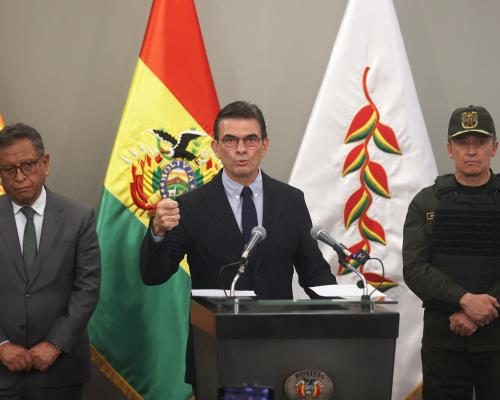
Marset's arrest is also notable for its implications regarding international law enforcement cooperation. Marco Antonio Oviedo, Bolivia's interior minister, announced that Marset is being extradited to the United States, where he faces charges related to drug trafficking and money laundering through American banks. This extradition marks a significant shift in Bolivia's stance toward cooperating with U.S. authorities, especially after nearly two decades of strained relations following the expulsion of the U.S. ambassador and the Drug Enforcement Administration under former President Evo Morales.
The current Bolivian government, led by President Rodrigo Paz, appears committed to restoring collaborative efforts to combat drug trafficking, a move that may bolster regional security and stability. Marset's case could serve as a litmus test for this renewed partnership.
Criminal Network and Past Arrests
Before his latest arrest, Marset had a long history of brushes with the law. He was first detained for drug trafficking in 2013 in Uruguay and subsequently spent several years in prison. During his incarceration, he allegedly forged connections with powerful organized crime groups, including Brazil's Primeiro Comando da Capital and Italy's 'Ndrangheta mafia. After his release in 2019, he fled to Paraguay using a fake Bolivian passport.
In Paraguay, he reportedly established drug trafficking routes that exploited Bolivia's status as both a cocaine producer and a transit hub for Peruvian cocaine. His operations extended to European markets, particularly in Belgium, the Netherlands, and Germany. In 2021, Marset was briefly detained in Dubai while traveling on a fake Paraguayan passport, but he managed to escape legal consequences after Uruguayan authorities issued him a new passport, leading to a scandal that resulted in the resignation of several officials.
Life on the Run in Bolivia
After moving to Bolivia in 2022, Marset adopted a new identity, using a Brazilian passport under the name Luis Paulo Amorim Santos. He seemed to evade capture while living a relatively public life, even purchasing a second-division football team and participating in matches that aired on local television. This audacious behavior illustrated his confidence in his ability to evade authorities.
However, his luck ran out when Bolivian police conducted a raid on his mansion in Santa Cruz de la Sierra in July 2023, only to find that he had already fled, apparently tipped off about the impending operation. For months, he remained on the run, taunting law enforcement through social media and even orchestrating a helicopter arrival for a television interview. Ultimately, Bolivian authorities managed to track him down in the same city from which he had previously escaped.
Marset's arrest is a significant development in the ongoing battle against drug trafficking in South America. As Bolivia strengthens its ties with international law enforcement, this case underscores the complexities and dangers of combating organized crime in the region. The future of Marset's criminal network remains uncertain, but law enforcement agencies are likely to intensify their efforts to dismantle it.
Originally reported by The Guardian. View original.