
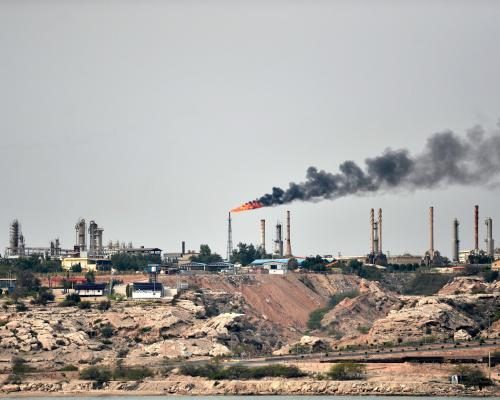
Former President Donald Trump announced on Friday that U.S. forces have "obliterated" military targets located on Iran's Kharg Island, a crucial hub for the country's oil exports. The statement, shared via social media, included a stark warning that the island's oil infrastructure could be next on the list of military targets. "For reasons of decency, I have chosen NOT to wipe out the Oil Infrastructure on the Island," Trump wrote. "However, should Iran, or anyone else, do anything to interfere with the Free and Safe Passage of Ships through the Strait of Hormuz, I will immediately reconsider this decision."
Kharg Island sits in the Persian Gulf and acts as the primary terminal for Iran's oil exports. Until Trump's announcement, the island had remained largely untouched during the recent wave of U.S. and Israeli military operations against Iran. As he prepared to depart for Florida over the weekend, Trump addressed reporters traveling with him but did not elaborate on the specifics of the latest military actions. His comments come amid heightened tensions in the region, particularly concerning the Strait of Hormuz, which is vital for global oil trade. Originally reported by The Guardian.
Military Escalation and Economic Impact
Experts have expressed concern that military actions targeting Kharg Island could lead to significant spikes in oil prices. Neil Quilliam, a senior research fellow at the Chatham House think tank, warned that if Kharg Island were to be attacked, oil prices could surge from the $120 per barrel witnessed earlier this week to potentially $150. "It's too vital for global energy markets," Quilliam noted. The implications of such an increase in oil prices would ripple through the global economy, affecting everything from consumer goods to transportation costs.
The U.S. military has already ramped up its presence in the region in response to escalating tensions. Earlier on Friday, a U.S. official confirmed to the Associated Press that 2,500 Marines and an amphibious assault ship had been ordered to the Middle East. These Marine Expeditionary Units are trained to conduct amphibious landings and are also capable of providing security at embassies, assisting with the evacuation of civilians, and participating in disaster relief efforts. However, this deployment does not necessarily indicate an imminent ground operation against Iran.
Concerns Over Shipping Routes
The Strait of Hormuz is one of the most crucial maritime chokepoints in the world, with approximately 20% of the global oil supply passing through its waters. Trump's remarks underline the administration's commitment to maintaining the security of these shipping routes, which have come under threat amid ongoing tensions between the U.S. and Iran. The potential for further Military Action Against Kharg Island raises questions about the stability of oil supply chains and the safety of commercial shipping in the region.
As the situation evolves, the international community is closely monitoring developments. Any disruption to shipping in the Strait of Hormuz could trigger a broader conflict, drawing in various regional and global powers. Additionally, stakeholders in the oil market are bracing for volatility, knowing that any military engagement could have profound implications for supply and prices.
Strategic Implications for U.S.-Iran Relations
The recent events signify a notable escalation in U.S.-Iran relations, which have been fraught with tension since the U.S. withdrew from the Iran nuclear deal in 2018. Trump's comments reflect a hardline approach aimed at deterring Iran from further aggressive actions in the region. Iran has consistently maintained that it will not back down in the face of U.S. pressure, raising the stakes for all parties involved.
As the administration weighs its options, the broader geopolitical landscape remains uncertain. The potential for military action against critical infrastructure like Kharg Island could lead to unintended consequences, not only for Iran but for the entire region. Observers are left to speculate whether Trump's approach will lead to a resolution or further entrench conflict.
The situation continues to develop, and the international community watches closely, anticipating the next moves from both the U.S. and Iran. With the stakes higher than ever, the possibility of military confrontation looms large, raising questions about the future of U.S.-Iran relations and global oil markets.
Originally reported by The Guardian. View original.