
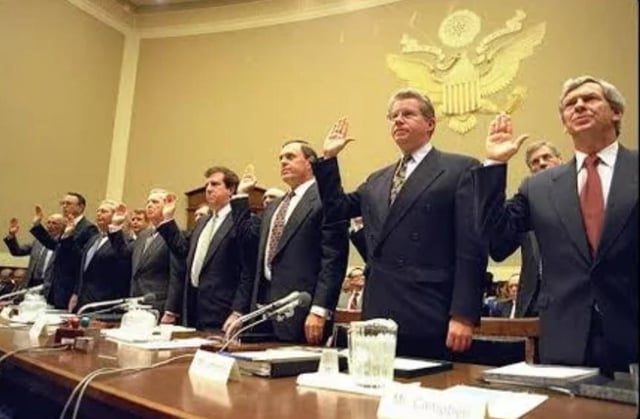
In a landmark courtroom moment back in 1994, executives from major tobacco companies testified under oath that they did not believe nicotine was addictive. This assertion raised eyebrows and sparked significant controversy regarding the tobacco industry's understanding of its products. The testimonies were part of a broader investigation into the health impacts of smoking and the legal responsibilities of tobacco manufacturers.
Tobacco Executives Under Oath
On April 14, 1994, the CEOs of several leading tobacco companies, including R.J. Reynolds Tobacco Company, Philip Morris, and Brown & Williamson, participated in a congressional hearing where they were questioned about the addictive nature of nicotine. During this session, key figures such as R. J. Reynolds' CEO, Edward Horrigan, and Philip Morris's then-CEO, William Campbell, declared under oath that they did not consider nicotine addictive. This testimony contradicted extensive scientific evidence linking nicotine to dependency. Originally reported by r/Damnthatsinteresting.
Horrigan directly stated, "I do not believe that nicotine is addictive," echoing a sentiment that reflected the companies' long-standing public relations strategy. The industry had historically denied the health risks associated with smoking, and these statements were part of their efforts to mitigate legal liabilities and public backlash.
Such testimony was not just a footnote in a legal proceeding; it was emblematic of a broader attempt by tobacco companies to downplay the dangers of their products. The hearing was part of a larger investigation spearheaded by Congress into the marketing practices of tobacco companies, particularly regarding youth smoking.
Public and Legal Reactions
The executives' claims ignited fierce criticism from public health advocates and lawmakers alike. Many in the health community cited extensive research demonstrating that nicotine is indeed addictive and plays a critical role in the development of tobacco dependence. The 1994 testimonies drew sharp rebukes from anti-smoking groups, who accused the tobacco companies of misleading the public.
In response to the executives' statements, the American Medical Association and various health organizations intensified their campaigns against smoking. The legal ramifications began to unfold almost immediately. Lawsuits aimed at holding tobacco companies accountable for the health consequences of smoking gained momentum, as the public outcry grew louder.
Furthermore, these hearings laid the groundwork for future regulations and legal actions against tobacco companies. By openly denying the addictive properties of nicotine, the executives placed their companies in a precarious position, ultimately leading to significant financial settlements and changes in tobacco marketing.
Shift in Public Perception
The 1994 testimonies marked a pivotal moment in the fight against tobacco use in the United States. As the public became more aware of the health risks associated with smoking, attitudes began to shift. Educational campaigns targeting youth smoking gained traction, and many states enacted stricter regulations on tobacco advertising.
Moreover, the revelations from the congressional hearings contributed to a growing body of evidence that would eventually lead to the 1998 Master Settlement Agreement, which required tobacco companies to pay billions to state governments and implement marketing restrictions. This agreement marked a significant turning point in how tobacco companies operated in the U.S.
While the tobacco industry continued to face challenges in the years following the testimonies, the seeds of change had been planted. The narrative surrounding smoking began to evolve, with a greater emphasis on cessation programs and public health initiatives aimed at reducing tobacco use.
Long-term Implications for Tobacco Regulation
The testimony of tobacco CEOs in 1994 fundamentally altered the landscape of tobacco regulation in America. As scientific evidence mounted linking nicotine addiction to smoking, public health policies began to reflect a more aggressive stance against tobacco use. This shift was characterized by increased taxation on tobacco products, graphic warning labels, and restrictions on advertising.
In the decades following the testimonies, many states implemented comprehensive smoking bans in public spaces, further reducing smoking rates. As a result, the health consequences of smoking have become a focal point in public health discussions, leading to a decline in smoking prevalence across the nation.
Looking back at the 1994 congressional hearing, it's clear how pivotal those moments were in reshaping public perceptions and regulatory frameworks surrounding tobacco use. While tobacco companies continue to navigate a more stringent regulatory environment, the legacy of those testimonies persists in ongoing public health efforts.
As discussions continue on the future of tobacco regulation, the lessons from the past remain relevant. The 1994 declarations serve as a reminder of the importance of accountability and transparency in the tobacco industry.
Originally reported by r/Damnthatsinteresting. View original.