
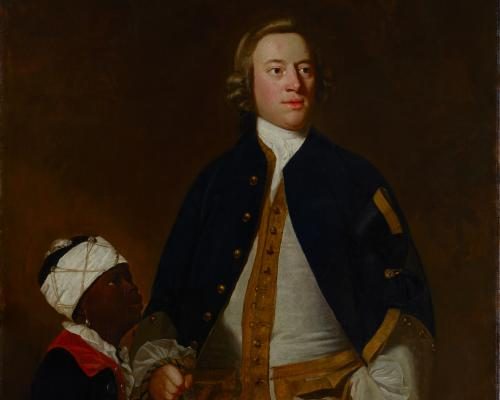
For centuries, an oil painting by Sir Joshua Reynolds depicting an enslaved boy known only as "Jersey" remained shrouded in mystery. It now emerges that Jersey, believed to be around 11 years old when captured in art around 1748, has a name and a story that deserve to be told. Recent research has unearthed significant details about his life, including his identity, military service, and hints of a potential path to freedom.
Unveiling Jersey's Identity
The portrait, showcasing Jersey alongside his master, naval officer Paul Henry Ourry, was displayed at Saltram, a National Trust Georgian mansion in Plympton, Devon. While Ourry stands confidently, looking into the distance, Jersey's expression is one of tentative reverence. This juxtaposition speaks volumes about the power dynamics of the time. Originally reported by The Guardian.
For years, art historians focused on Ourry, leaving Jersey's narrative largely untold. However, a collaborative research initiative led by the National Trust, the National Gallery in London, and Royal Museums Greenwich aims to shed light on overlooked historical figures like Jersey. Volunteer researcher Mark Brayshay emphasized the project's goal: "Could we acknowledge and honour him as a distinct individual?"
Research Breakthroughs and Historical Context
The research team scoured admiralty records, muster books, and captains' logs to gather information about Jersey. They discovered references to him as "Boston Jersey" on ships associated with Ourry, suggesting that the name originated from Ourry's birth in the Channel Islands, while "Boston" may indicate a previous residence in Massachusetts. The baptismal certificate found later reveals that Jersey was baptized as George Walker on July 30, 1752, in Westminster, at approximately 15 years of age.
This documentation allows researchers to piece together Jersey's life. Brayshay noted that a muster from 1751 indicates he may have been a crew member rather than merely a servant. In fact, he appears as one of ten crew members eligible for discharge, which could imply he was receiving wages from the Royal Navy, although these funds may have been directed to Ourry instead. Jersey was officially discharged from another ship in the summer of 1753, after which he seemingly disappears from historical records.
New Discoveries and Historical Implications
Historians speculate on Jersey's fate post-discharge. There are theories suggesting he could have been sold to another master or, alternatively, granted freedom and joined a different vessel. This uncertainty continues to compound the complexities of his life story. Renowned historian David Olusoga remarked on the importance of this research, stating, "This project asks us to look more closely at a familiar past, revealing a life long obscured and reminding us that history is shaped as much by those rendered invisible as by those remembered."
Technical examinations of the portrait itself have revealed Reynolds' artistic process. Initially, he considered an elaborate natural background filled with leafy branches but ultimately chose a simpler brown backdrop. Restoration efforts have since revived lost details, notably Jersey's facial features and the intricate design of his clothing, allowing viewers to appreciate the painting in a new light. Zoe Shearman, the property curator at Saltram, highlighted that understanding the painting through a contemporary lens has deepened the appreciation of Jersey's portrayal.
Revisiting Art and History
This research has not only placed Jersey's identity at the forefront but has also contextualized Reynolds' work within a broader historical narrative. The painting will be displayed at Saltram starting May 9, alongside another Reynolds portrait of Captain George Edgcumbe, marking the first time these artworks have been together in over two centuries. This pairing offers an opportunity for viewers to engage with the historical context and the stories behind both figures.
As more discoveries come to light, the journey of Boston Jersey continues to evolve. The initiative to recognize him as a person rather than a mere subject in a portrait helps address the silences within our collective history. The ongoing research serves as a reminder of the importance of acknowledging those whose voices have been lost, restoring their stories to the forefront of historical discourse.
Originally reported by The Guardian. View original.