
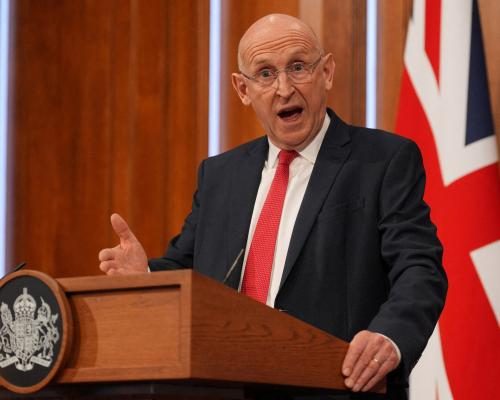
Britain's Defence Secretary John Healey has emphasized that the United States should evaluate the UK's contributions in the Gulf region based on its actions rather than the social media posts of former President Donald Trump. Speaking at a conference in London, Healey underscored the significance of recent UK initiatives aimed at securing vital shipping routes through the Strait of Hormuz.
Healey's remarks came as Labour leader Keir Starmer returned from a diplomatic mission to the Gulf, where he engaged in discussions with Trump regarding strategies to maintain the security of the Strait of Hormuz. Starmer's trip also included meetings with leaders from Saudi Arabia, the United Arab Emirates, and Bahrain. "Even in this current conflict, the basing permissions that we in the UK have agreed with the US have been invaluable to their military operations," Healey stated, advocating for a focus on actions over rhetoric. Originally reported by The Guardian.
UK's Role in Regional Security
The UK has taken a proactive stance in addressing the ongoing tensions in the Gulf, particularly in light of the fragile ceasefire announced by Trump. This ceasefire, as acknowledged by Starmer, is seen as tenuous by regional leaders, who are concerned about Iran's activities and Israel's military actions in Lebanon. Healey's assertion that the UK's recent actions "spoke for themselves" reflects a commitment to ensuring maritime safety and stability in the region.
Prior to the ceasefire announcement, the UK led a coalition of military planners from 35 nations to strategize on securing the Strait of Hormuz. This initiative included discussions on the removal of Iranian mines, which pose a significant threat to shipping lanes. The UK's collaborative efforts highlight its leadership role in fostering international cooperation to navigate complex geopolitical challenges.
Starmer's Diplomatic Engagements
During his trip, Starmer engaged directly with Trump, articulating the concerns of Gulf nations regarding the ceasefire's longevity. "I had a discussion with President Trump last night and set out to him the views of the region here. These Gulf states are the neighbours of Iran, and therefore, if the ceasefire is to hold - and we hope it will - it has to involve them," Starmer explained. His discussions with Gulf leaders emphasized the need for a practical plan to ensure safe navigation through the Strait of Hormuz, which is critical for global oil supplies.
Starmer also highlighted the necessity of preventing Iran from imposing tolls on vessels passing through the strait, a concern that aligns with the views expressed by regional allies. Earlier this week, Trump suggested a potential "joint venture" with Iran regarding tolls, a notion that has raised eyebrows among UK officials and Gulf leaders alike.
Challenges Ahead for NATO and Regional Stability
The dialogue surrounding the Gulf situation is further complicated by Trump's dissatisfaction with NATO allies over their perceived lack of support during the ongoing conflict with Iran. Reports indicate that Washington plans to audit NATO members to determine if any should face repercussions for not backing the US military actions effectively. Starmer acknowledged the importance of European NATO members contributing more, emphasizing that the alliance serves not only American interests but also those of its allies.
"We're very strong supporters of NATO and I've been making the argument for some considerable time that we need to do more," Starmer asserted. He reiterated NATO's critical role in maintaining security, stating, "It's the single most effective military alliance the world has ever known. NATO is a defensive alliance, which for decades has kept us much safer than we would otherwise have been." This sentiment underscores the UK's commitment to strengthening transatlantic ties as geopolitical tensions escalate.
As the situation in the Gulf remains fluid, the UK's focus on actions rather than mere rhetoric will be crucial in navigating these challenges. The international community's response to the ongoing instability will likely shape future engagements and security arrangements in this vital region.
Moving forward, the UK's diplomatic initiatives and military collaborations will be essential in ensuring the Strait of Hormuz remains a safe passage for global trade, while also addressing the broader implications of regional conflicts. The actions taken by the UK and its allies will be closely scrutinized as they work to maintain stability in a volatile landscape.
Originally reported by The Guardian. View original.