
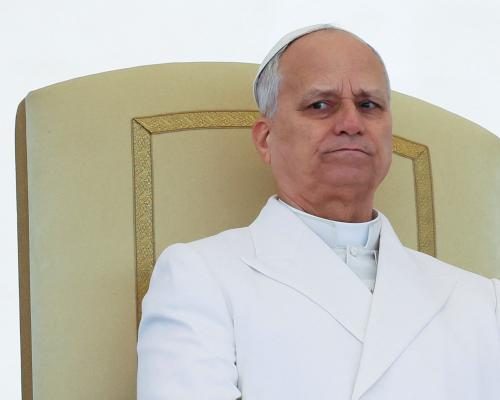
As Pope Leo celebrates his inaugural Easter as pontiff, nearly a year after the passing of his predecessor, the Catholic community is still contemplating the nature of his leadership. This pivotal feast, the most significant in the Church's liturgical calendar, unfolds amidst escalating tensions in the Middle East, ignited by recent US-Israeli military actions in Iran. Unlike his predecessor, Pope Francis, who was known for his charismatic and often confrontational approach, Leo adopts a more diplomatic and mild-mannered stance, which has prompted mixed reactions among the faithful.
Reflections Amidst Global Turmoil
In his first Easter address, Pope Leo has faced the challenge of addressing a world marred by conflict and strife. The ongoing war in the Middle East has heightened the stakes for his message of peace and reconciliation. During his Palm Sunday remarks, he offered a pointed critique of global leadership, suggesting that God turns away from leaders whose hands are "full of blood." This statement was seen as a veiled rebuke of both US President Donald Trump and Israeli Prime Minister Benjamin Netanyahu, reflecting Leo's intention to navigate the complex political landscape with a firm yet diplomatic tone. Originally reported by The Guardian.
Joanne Coleman, a religion teacher from Ireland, expressed a desire for Leo to adopt a more outspoken stance on current global issues. "I think he's a good person with good intentions, but he must get louder, especially with Trump," she remarked during the pope's general audience in St. Peter's Square. This sentiment resonates with others who feel that the time for timidity has passed, especially given the magnitude of ongoing conflicts.
Diplomacy Over Confrontation
Since his election, Pope Leo has drawn comparisons to Pope Francis, particularly regarding their approaches to global issues. While Francis was often outspoken about Trump's policies on immigration and climate change, Leo has opted for a more restrained style. As Cardinal Robert Prevost, Leo had openly criticized the Trump administration's immigration strategies, setting expectations for a similarly fervent papacy. However, within weeks of his election, he hosted prominent US politicians, including Trump's key allies, signaling a shift towards a more diplomatic approach.
Iacopo Scaramuzzi, a Vatican correspondent for La Repubblica, describes Leo as a pragmatic leader whose actions speak louder than words. "His strategy is calibrated not on the resonance of his words but on the efficacy of his actions," Scaramuzzi noted, pointing to the Vatican's role in mediating conflicts in Venezuela and Cuba. This behind-the-scenes approach, while appearing soft, is seen as a strength in navigating international relations.
A Call for More Explicit Condemnation
Despite Leo's cautious diplomacy, some Catholics hope he will take a firmer stance on the violence in the Middle East. His recent condemnation of the Gaza conflict, where he labeled the military actions as "barbarity," shows an increasing willingness to address contentious issues directly. Following a clash involving Israeli police that obstructed a Catholic archbishop from conducting mass, US and European officials expressed their criticism, leading to an apology from Israeli authorities-a move believed to be influenced by Leo.
Moreover, Leo's reliance on his college of cardinals to voice stronger condemnations of the US-Israeli military actions indicates the Church's strategy to balance diplomacy with moral authority. Cardinal Domenico Battaglia's open letter condemning arms dealers and Cardinal Robert McElroy's assertion that the conflict does not meet the criteria for a just war reflect the Church's ongoing dialogue about peace and justice in the face of war.
Anticipation for Easter Sunday
As Easter approaches, many are eager to see how Pope Leo will weave his call for peace into his message. While he may refrain from naming specific leaders, there is an expectation that his address will emphasize the need for peace in the Middle East and beyond. As tensions continue to mount, Leo's careful navigation of these issues highlights his commitment to a moral framework, even amidst the complexities of international politics.
With the world watching, Pope Leo's inaugural Easter not only commemorates a significant moment in his papacy but also serves as a litmus test for his approach to global challenges. His ability to balance diplomacy with a clear moral stance will be critical in shaping the future of the Catholic Church's engagement with the world.
Originally reported by The Guardian. View original.