
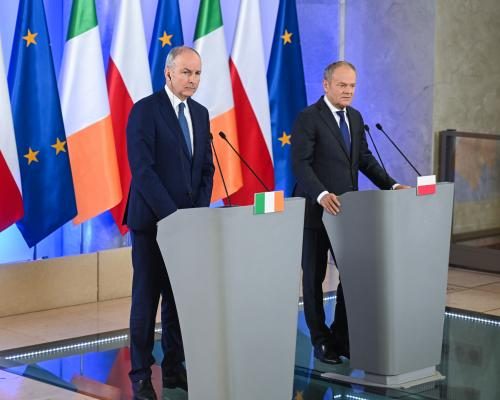
Poland and Ireland's leaders have condemned the Hungarian government's alleged attempts to manipulate EU sanctions against Russia, following the release of leaked audio involving Foreign Minister Péter Szijjártó. The audio, which surfaced just days before Hungary's parliamentary elections, has intensified scrutiny on Prime Minister Viktor Orbán's administration, which has long been accused of cozying up to Moscow.
Leaked Conversations Raise Alarms
A joint media investigation published on Tuesday revealed purported phone conversations between Szijjártó and Russian Foreign Minister Sergei Lavrov. In one instance, Szijjártó allegedly states, "I am always at your disposal," suggesting a troubling level of deference to Russian interests. The investigation, conducted by The Insider, alongside regional outlets like VSquare and Delfi, has heightened concerns that Hungary is acting as a proxy for Russia within the European Union. Originally reported by The Guardian.
The timing of the leak is particularly sensitive, occurring just days before the elections on April 12, where Orbán is facing significant challenges to his 16-year rule. His administration has been criticized for undermining democratic institutions and eroding media freedom. Polls indicate that Orbán and his Fidesz party are currently trailing behind opposition candidate Péter Magyar and his Tisza party, making the stakes of this election particularly high.
EU Leaders Express Outrage
In the wake of the revelations, Polish Prime Minister Donald Tusk described the leaked audio as "disheartening" and indicative of a "deeply disturbing" relationship between Budapest and Moscow. Tusk emphasized the gravity of a foreign minister of an EU country allegedly reporting to the Russian foreign minister, remarking, "One could hardly imagine anything more repulsive." His comments reflect a broader sentiment among EU leaders, who view Hungary's actions as a betrayal of collective European values.
Echoing this sentiment, Irish Prime Minister Micheál Martin labeled the situation "sinister," criticizing the "deferential tone" in Szijjártó's statements to Lavrov. Martin's remarks underline the growing apprehension among EU officials about Hungary's alignment with Russia, especially amid ongoing tensions related to the Ukraine conflict.
Hungary's Response and Political Fallout
In response to the leaked audio, Szijjártó did not deny the conversations took place but claimed they were intercepted unlawfully. He characterized the situation as a "huge scandal," suggesting that foreign secret services had been wiretapping his communications and releasing them strategically ahead of the elections. His defense raises questions about the integrity of Hungary's foreign policy and its implications for EU unity.
Critics have long accused Orbán of acting as a "Trojan horse" for Russian interests within the EU, particularly following his reluctance to support sanctions against Russia after its invasion of Ukraine. The leaked conversations add credibility to these allegations, reinforcing the narrative that Hungary may be undermining EU solidarity in favor of Moscow.
Implications for EU and Global Politics
The implications of this political turmoil extend beyond Hungary. As Orbán's government grapples with internal dissent and external criticism, the outcome of the upcoming elections could have significant repercussions for the European political landscape. A victory for the opposition could signal a shift away from Orbán's controversial policies and a reassertion of democratic norms in Hungary.
Furthermore, the election results are being closely monitored by far-right movements across Europe and globally, as they could either bolster or weaken populist sentiments. Many observers are watching to see if a more pro-European government emerges, potentially reshaping Hungary's role within the EU and its stance towards Russia.
This situation is a crucial moment for Hungary, the EU, and international relations at large. As the election approaches, the spotlight is firmly on Orbán and his administration, with the potential to either reinforce or challenge the current trajectory of Hungarian politics and its alignments on the global stage.
Originally reported by The Guardian. View original.