
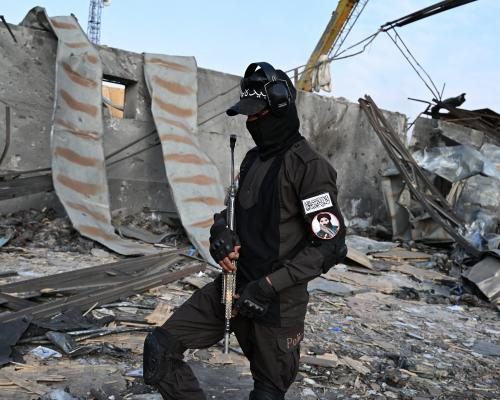
Pakistan has intensified its airstrike campaign against Taliban targets in Afghanistan, aiming to compel the Taliban authorities to cease their support for Pakistani militant groups. Officials and experts indicate that this strategy seeks to impose significant costs on the Taliban regime, hoping it will act to prevent attacks that have increasingly targeted Pakistan from across the border. However, this approach carries inherent risks of escalating violence and retaliation.
On Tuesday, Afghan authorities reported a devastating airstrike in Kabul that allegedly struck a drug rehabilitation center, resulting in the deaths of around 400 people. Pakistan has dismissed these claims as propaganda, asserting that its airstrikes target only military and terrorist infrastructure. The uptick in violence comes in the wake of a surge in terrorist attacks within Pakistan, which Islamabad attributes to militant groups finding sanctuary in Afghanistan since the Taliban regained power in 2021. Originally reported by The Guardian.
Ghazab lil-Haq: A New Offensive
In response to the growing threat, Pakistan has launched an operation named Ghazab lil-Haq, or "Righteous Fury." This operation reflects a shift in Pakistan's military strategy, as officials express that their patience has run thin. A senior security official stated, "As Pakistan faces a rise in bloodshed, Afghanistan should also suffer. Why should they live in peace?" This rhetoric highlights the increasingly strained relations between the two neighboring countries since the Taliban's return to power.
The Taliban has condemned the airstrikes, labeling them a violation of Afghan sovereignty and promising retaliation. Taliban Defense Minister Mohammad Yaqoob, the son of the movement's founder, Mullah Omar, declared, "They should not think that they can martyr people in Kabul, destroy the city and disturb its security, while remaining safe in Islamabad." This statement underscores the potential for further violence and destabilization in the region.
Comparisons to Global Conflicts
Amir Khan Muttaqi, the Taliban's foreign minister, has drawn parallels between Pakistan's airstrikes and Israel's military actions in Gaza, suggesting that such operations are a betrayal from a neighboring Muslim country. This comparison seeks to evoke a sense of solidarity among Muslims while framing Pakistan's actions as aggressive and unjust. The Taliban's position indicates a readiness to escalate conflict, with hints of deploying suicide bombers as part of their response.
Some airstrikes are rumored to have targeted specific Taliban leaders, reflecting a significant escalation in Pakistan's military engagement. However, analysts caution that such military actions may not yield the desired outcomes. Pakistan's past support for various armed factions in Afghanistan has often backfired, leading to further instability.
Complex Historical Context
Pakistan's current military leadership, under Field Marshal Asim Munir, is characterized by a more aggressive posture. Observers note that Munir's approach emphasizes the necessity of a strong response to perceived threats. Qamar Cheema, executive director of the Sanober Institute, stated, "The military leadership at the moment has a view that we need to act hard, we need to act strong, we need to be bold and we need to deal with the threat wherever it is." This approach indicates a willingness to explore all available options, even those that could further complicate the regional dynamics.
Pakistan's strategy has also included closing borders for trade with Afghanistan and expelling hundreds of thousands of Afghan refugees. Despite these actions, officials maintain that they have no quarrel with the Afghan people, emphasizing that the airstrikes are conducted based on intelligence to protect Pakistani citizens from terrorism.
Aizaz Ahmad Chaudhry, a former senior diplomat, has articulated concerns over the Taliban's governance style, describing it as operating like a militia rather than a legitimate government. Chaudhry remarked, "The Taliban are running the state as a militia, rather than a government that cares for its people," highlighting the lack of effective governance in Afghanistan that could address security concerns.
As tensions continue to escalate between Pakistan and the Taliban, the potential for widespread violence looms large. The interNational community's withdrawal from Afghanistan has left Pakistan to navigate a complex and volatile landscape, raising questions about the effectiveness of military strategies in achieving long-term stability. Asif Durrani, Pakistan's former special envoy for Afghanistan, noted, "Pakistan has borne the pain. This is payback time." With the situation rapidly evolving, both nations stand at a precarious crossroads.
Originally reported by The Guardian. View original.