
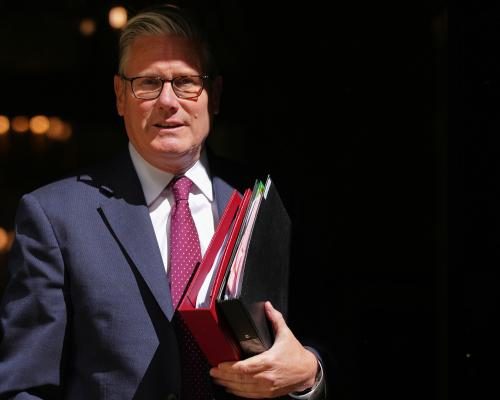
In a strategic move ahead of the elections, Labour's leadership has opted to keep Prime Minister Keir Starmer off the campaign trail, with Pat McFadden, Secretary of State for Work and Pensions, stepping in to manage public relations. As election day approaches, the party grapples with stark polling results indicating that Starmer's presence could detract from Labour's chances. Canvassers across the nation have echoed this sentiment, revealing that mentions of Starmer lead many voters to turn away, indicating a significant disconnect between the party leadership and public sentiment.
Downing Street's Cautious Strategy
In the hours leading up to the elections, Downing Street has adopted a quiet strategy, believing that Starmer's visibility could jeopardize Labour's prospects. As canvassers reported growing voter discontent linked to Starmer's name, the party's approach has shifted to a more cautious stance. The decision to minimize Starmer's public exposure reflects a broader concern: the prime minister has become what some describe as 'kryptonite' to Labour's electoral aspirations. Reports indicate that simply mentioning his name has caused voters to physically recoil, with some even making the sign of the cross. Originally reported by The Guardian.
Pat McFadden has emerged as a steadfast supporter in this tumultuous political landscape. Tasked with the daunting responsibility of defending the party's position, he downplayed concerns over Starmer's low visibility, arguing that the prime minister has been dedicated to pressing national issues. According to McFadden, Starmer has focused on coordinating responses to antisemitism and managing the fallout from ongoing international conflicts, which he claims takes precedence over traditional campaign activities. 'It would have been a dereliction of duty for Keir to have taken time out of his schedule,' McFadden stated, emphasizing the serious nature of the challenges the country faces.
Defending Starmer's Leadership Amidst Doubts
Despite the evident skepticism surrounding Starmer's leadership, McFadden expressed unwavering loyalty to the prime minister's agenda. He argued that the current political landscape is fraught with self-serving motivations from other parties, asserting that Labour's commitment to tackling real issues sets them apart. He conveyed that Starmer's approach-losing seats in the elections-could paradoxically signify a commitment to governance over electoral opportunism. 'In fact, Keir saw it as a badge of honour for Labour to lose as many seats and councils as possible,' McFadden claimed, attempting to frame potential losses as indicative of a principled stand.
However, the underlying concern remains: should Labour perform poorly in the elections, the party's internal dynamics may shift. McFadden was quick to dismiss speculation regarding leadership challenges, maintaining that loyalty to Starmer endures among key figures. He noted that Wes Streeting, a prominent supporter, reassured Starmer of his backing amidst rumors of dissent. 'Wes had even phoned Keir to say he had no idea where all those rumours that he was planning a coup had come from,' McFadden recounted, underscoring the narrative of unity within the party.
The Future of Labour's Leadership
Looking ahead, McFadden's commentary provides insight into Labour's strategy post-election. Regardless of the results, he insists that Starmer will remain in power, committed to his five-year term. He confidently asserted, 'Whatever happened on Thursday, the prime minister would be going nowhere on Friday. Or Saturday. Or Sunday.' This steadfastness, however, could face scrutiny if Labour's performance does not meet minimal expectations. Despite McFadden's attempts to manage expectations, there remains a delicate balance between leadership loyalty and public perception.
As the election results loom, McFadden's defense of Starmer may be tested. Political analysts suggest that the party's ability to adapt to voter feedback will be crucial in navigating the post-election landscape. Should Labour fare worse than anticipated, the pressure for change could intensify, leaving Starmer's future as leader in question. With murmurs of potential reshuffles and speculation about party dynamics, the coming days will be pivotal in determining Labour's direction, as well as Starmer's hold on leadership.
Originally reported by The Guardian. View original.