
SINGAPORE - The release of GLM-5 as an open-source model marks a pivotal moment in the evolution of artificial intelligence. Unveiled on February 19, 2026, this cutting-edge model transitions large language models (LLMs) from generating simple code snippets to constructing entire systems and executing intricate, end-to-end tasks. This development signifies a shift from the previously casual approach termed "vibe coding" to a more sophisticated practice known as agentic engineering.
GLM-5's Advanced Capabilities
Designed to excel in complex programming environments, GLM-5 ranks among the most powerful open-source models available, particularly for coding and autonomous task management. Its capabilities are on par with the proprietary Claude Opus 4.5, especially when tackling complex system designs or long-term projects that necessitate sustained planning. The model boasts an impressive parameter count, ramping up from 355 billion to a staggering 744 billion. Additionally, the number of active parameters has increased from 32 billion to 40 billion, reflecting substantial advancements in its architecture.
Moreover, the volume of pre-training data has skyrocketed to 28.5 trillion tokens, enabling the model to leverage a vast amount of information. Innovations in training methods, particularly through a framework called Slime, allow for asynchronous reinforcement learning at a scale previously unseen. This enables GLM-5 to continuously learn from extended interactions, significantly enhancing its efficiency post-training.
Efficiency and Performance Metrics
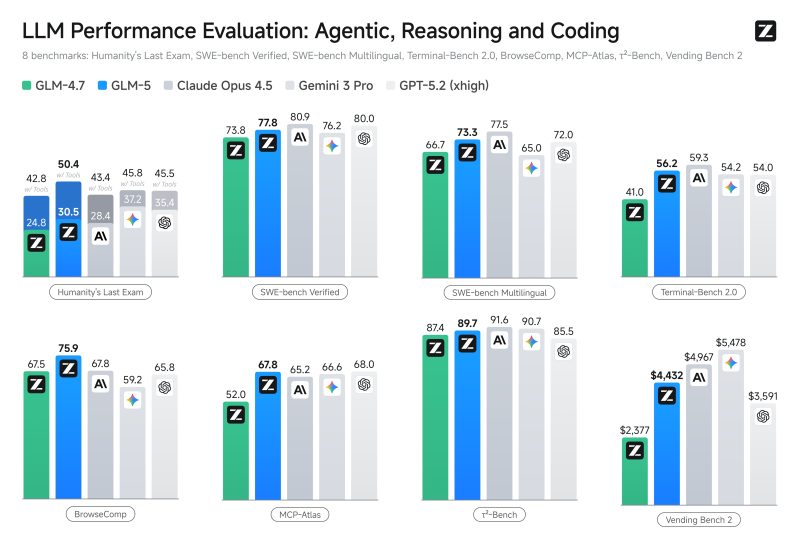
GLM-5 introduces a feature called DeepSeek Sparse Attention, which optimizes performance over long contexts while reducing deployment costs and improving token efficiency. The model's performance on various benchmarks is remarkable. In the SWE-bench-Verified and Terminal Bench 2.0 evaluations, GLM-5 achieved scores of 77.8 and 56.2, respectively, marking the highest reported results among open-source models. Notably, it outperformed Gemini 3 Pro in numerous software-engineering tasks, showcasing its superior capabilities in the field.
In practical applications, GLM-5 has also excelled in economic simulations. During the Vending Bench 2 assessment, which simulates managing a vending machine business over one year, the model concluded with a balance of $4,432, outpacing other open-source models in operational management and economic performance. These outcomes underscore its ability to maintain long-term goals, manage resources effectively, and coordinate complex processes.
Implications for the Future of AI
The emergence of GLM-5 signifies a broader evolution in AI capabilities. As models progress from simply writing code to delivering fully operational systems, the potential applications of such technologies expand dramatically. The shift to agentic engineering could redefine workflows across various sectors, offering organizations powerful tools to automate tasks that previously required human intervention.
Furthermore, this transition raises important questions about the future of work in the tech industry. With the ability to handle sophisticated tasks, AI models like GLM-5 could potentially displace certain job functions, while simultaneously creating new opportunities in AI oversight, management, and innovation. As businesses adapt to these changes, the integration of AI into everyday operations will likely accelerate.
Access and Community Engagement
For those interested in exploring GLM-5, the model is available through open-source repositories. Users can access it via GitHub and Hugging Face, making it an accessible resource for developers and researchers alike. This open-source approach not only fosters community engagement but also encourages collaborative improvements and innovations built upon the model.
As the AI landscape continues to evolve, the implications of GLM-5's capabilities will be significant. By enabling LLMs to take on more complex and varied tasks, we may witness a transformation in how technology is integrated into various fields, enhancing productivity and efficiency. As organizations begin to embrace these advances, the future of artificial intelligence looks promising, offering a glimpse into a world where AI not only assists but also engineers.