
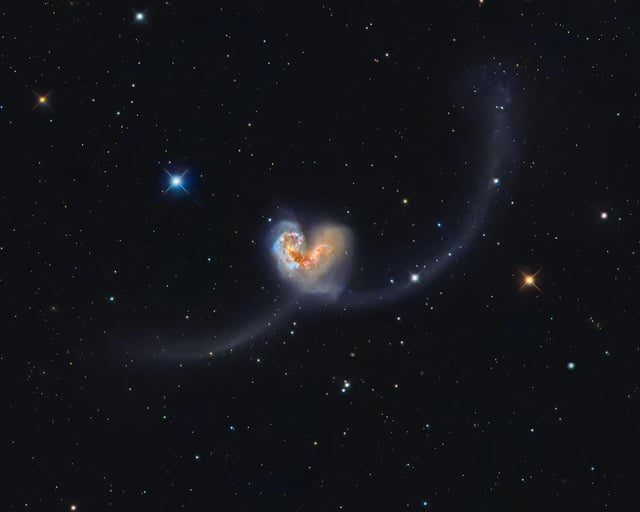
A stunning photograph captures the moment two galaxies have been colliding for over 600 million years, forming a heart shape in the cosmos. This striking image, taken by amateur astrophotographer Prathamesh Jaju, showcases the beauty and complexity of our universe, revealing how even chaotic events can produce astonishing patterns.
Galactic Collision: A 600 Million-Year Journey
The galaxies, known as NGC 4038 and NGC 4039, have been on a collision course for a staggering 600 million years. This pair, situated approximately 100 million light-years away in the constellation Corvus, has become a favorite among astronomers and space enthusiasts alike. Jaju's photograph not only captures their ongoing interaction but also highlights the heart shape formed as the galaxies draw closer. Such collisions are common in the universe, playing a crucial role in galaxy evolution. Originally reported by r/space.
This particular interaction demonstrates the gravitational forces at work, pulling stars, gas, and dust from each galaxy into a mesmerizing spiral. As the two galaxies merge, they create new stars and influence the structure of both galaxies, leading to the birth of new cosmic phenomena. This captivating image serves as a reminder of the dynamic nature of the universe and the beauty that can emerge from chaos.
Astrophotographer's Technique and Inspiration
Prathamesh Jaju, the creator of this breathtaking photograph, utilized a combination of advanced imaging techniques to capture the galaxies. His dedication to astrophotography began years ago, fueled by a passion for the night sky and a desire to share the wonders of the universe. Jaju's work has gained recognition within the astronomy community, showcasing the potential of amateur astronomers to contribute significant observations and artistic interpretations of cosmic events.
In his own words, Jaju expressed, "I was astonished to see the heart shape emerge amidst the collision. It symbolizes love and unity, even in a chaotic event like this." His enthusiasm for astrophotography is evident in his meticulous approach to capturing celestial objects. By employing techniques such as long-exposure imaging and stacking multiple frames, he achieved a level of detail that reveals intricate structures within the galaxies.
The Science Behind Galactic Mergers
Galactic collisions like the one between NGC 4038 and NGC 4039 are not just visually stunning; they also have significant implications for our understanding of cosmic evolution. These events can lead to increased star formation as gas clouds collide, creating an environment ripe for new stars to ignite. Over time, as galaxies merge, they can form larger structures known as elliptical galaxies.
The heart-shaped formation captured in Jaju's photograph may appear whimsical, but it serves as a powerful reminder of the forces at play in the universe. As galaxies interact, their gravitational pull distorts their shapes, often leading to peculiar formations that challenge our understanding of cosmic dynamics. Scientists continue to study such phenomena, gaining insights into the life cycles of galaxies and the evolution of the universe itself.
Public Reaction and Future of Astrophotography
The response to Jaju's photograph has been overwhelmingly positive, with many expressing admiration for both the artistic quality and the scientific significance of the image. Social media platforms have played a key role in amplifying the reach of such stunning photographs, allowing amateur astronomers to share their work with a global audience.
As technology continues to advance, the future of astrophotography looks bright. Innovations in telescope design, imaging software, and processing techniques empower enthusiasts to capture ever more detailed and striking images of the night sky. Jaju's work exemplifies this trend, inspiring others to explore the cosmos and document its wonders.
Looking ahead, the field of astrophotography is likely to expand, with more individuals joining the ranks of passionate stargazers. As they continue to photograph celestial events and share their findings, the world may witness even more breathtaking images that highlight the beauty and complexity of our universe.
Originally reported by r/space. View original.