
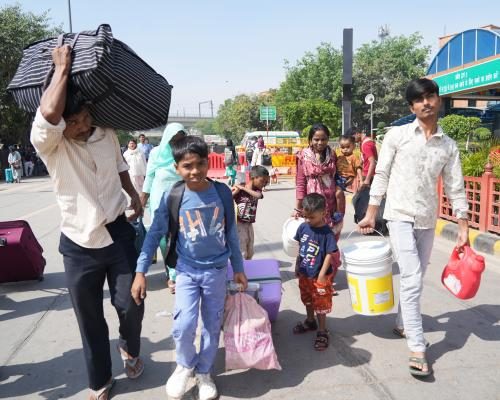
As rising food prices and fuel shortages grip India, families are abandoning urban life in search of basic necessities. Raju Prasad, a 35-year-old ragpicker, is among many migrant workers who have decided to leave Delhi for their rural villages. He and his family, comprising seven members, are heading back to Gorakhpur, Uttar Pradesh, after nearly a year in the capital, driven by desperation amid a worsening crisis.
Desperation Fuels Reverse Migration
At 9 a.m. on a Saturday, Raju Prasad rushes through Anand Vihar railway station in Delhi, burdened by a heavy bag over his shoulder. His wife holds their youngest daughter while clutching a white plastic bucket, and their three other children follow closely behind. The family moved to Delhi nine months ago, hoping for better economic opportunities, but rising food costs and the impact of the Middle East fuel crisis have turned their dreams of stability into a fight for survival. Originally reported by The Guardian.
"If we stay here even a few more days, our children might die of hunger," Prasad said, reflecting on their dire situation. Their last gas cylinder ran out 15 days ago, leaving them to rely on firewood, which has also become scarce. "Our savings are almost gone, so we decided to return to the village - at least there, we can cook on a temporary mud stove," he added. The Prasad family's plight highlights the larger trend of reverse migration, as many workers from states like Uttar Pradesh, Bihar, and Jharkhand abandon the capital.
Fuel Shortages and Rising Prices Impact Daily Life
Delhi, home to millions of migrant workers, is facing an unprecedented crisis fueled by skyrocketing global fuel prices stemming from the conflict in the Middle East. This has destabilized daily life, particularly for those relying on affordable street food from dhabas and small eateries. With vendors closing shop due to rising costs and an inability to secure gas, many are left without options.
"I've not had proper food for the past two days. All my savings are gone," said 25-year-old Sarfaraz from Bihar, who has been waiting for money from family to afford a train ticket home. Sarfaraz came to Delhi to work at the Jewar Noida International Airport construction site, earning about 550 rupees a day. Now, he finds himself trapped in a cycle of desperation as the price of gas cylinders on the black market has soared from 900 rupees to 4,500 rupees. "Even outside, food has become too expensive. Prices have doubled, and we cannot afford to eat," he lamented.
Businesses Struggle Amid Economic Turmoil
The situation is equally dire for small business owners in the city. Anil, who has run a restaurant in Nehru Place for 30 years, has never seen a crisis like this. "It is the first time in my life that the gas cylinder price on the black market has reached 4,500 rupees. I have had to increase prices and cut down many items from the menu," he explained. To cope, he has reverted to cooking with traditional open-fire methods, but he worries about the future. "If this situation continues, it will affect my workers too," he said, highlighting the ripple effect on employment and livelihoods.
The government has claimed that those who book gas cylinders online can receive them within days, yet many report long waits and uncertainty. Migrant workers and students, who often lack access to domestic gas consumer cards, are particularly vulnerable. Amid this chaos, eateries across cities like Delhi, Mumbai, Pune, and Lucknow are reducing menus, raising prices, or closing entirely.
Government Response and Future Outlook
Praveen Shankar Kapoor, the BJP's Delhi spokesperson, stated that authorities are actively working to stabilize supply chains for both household and commercial LPG. He acknowledged that smaller cylinder users are facing acute challenges. "Yes, the 5kg LPG category is facing more acute challenges at the moment, especially among migrant and low-income groups," he admitted.
The ongoing fuel crisis has not only affected individual families like the Prasads and Sarfaraz but has also begun to reshape the economic landscape of cities that heavily rely on migrant labor. As families return to their villages, the impact on urban economies will likely become more pronounced, making it essential for authorities to address the underlying issues quickly.
With rising fuel prices and food shortages showing no signs of abating, the plight of migrant workers across India remains a pressing concern. The struggle for basic survival may force many more to abandon their urban aspirations, highlighting the urgent need for effective solutions to restore stability.
Originally reported by The Guardian. View original.