
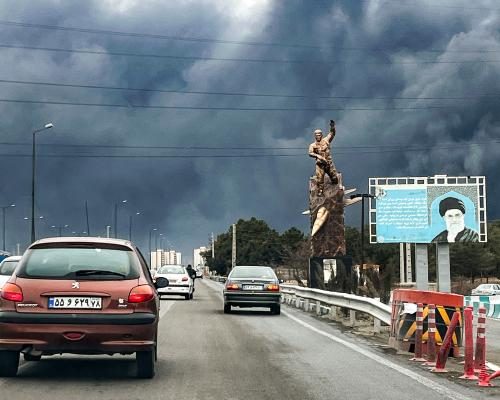
The Middle East remains engulfed in turmoil as Israel intensifies its military actions against Iran, with President Donald Trump issuing stark warnings regarding Tehran's new leadership. Recent missile strikes on oil depots in Tehran have left the city shrouded in black smoke, underscoring the escalating conflict. Trump, who was seen taking a golf break during the strikes, emphasized that Iran's new leader must secure his approval to maintain power, stating, "He's going to have to get approval from us. If he doesn't get approval from us he's not going to last long."
US Airstrikes and Trump's Bold Assertions
The latest developments come as US airstrikes against Iranian targets continue, with Trump asserting that the newly appointed Iranian leader will not endure without American backing. "We want to make sure that we don't have to go back every 10 years," he said during an interview with ABC News, referencing the potential for Iran to develop nuclear capabilities. Trump expressed his willingness to accept candidates with ties to the previous regime, stating, "I would, in order to choose a good leader I would, yeah, I would." Originally reported by The Guardian.
Trump further indicated a readiness to deploy US forces to secure Iran's estimated 460kg of enriched uranium, which the International Atomic Energy Agency (IAEA) considers out of regulatory control. "Everything is on the table. Everything," he affirmed, while remaining vague about the duration of military actions, saying, "I don't know. I never predict."
Economic Fallout and Rising Fuel Prices
The ongoing conflict has had immediate repercussions for the US economy, with rising fuel prices adding to the burden of an economy already shaken by the loss of 92,000 jobs in February. The national average for regular gasoline has surged to $3.32 per gallon, marking an 11% increase in just one week and the highest level since September 2024. Diesel prices have seen an even steeper spike, jumping 15% to $4.33, the highest rate recorded since November 2023.
In response to the rising gas prices, Trump downplayed the situation, referring to it as "a little glitch." He noted, "I think it's fine. It's a little glitch. We had to take this detour." Despite the economic strains, the Trump administration defended a waiver on certain sanctions related to Russian oil, aimed at stabilizing global markets. Energy Secretary Chris Wright and US Ambassador to the UN Mike Waltz explained that the waiver is intended to alleviate fears of oil shortages and mitigate price spikes.
International Responses and Military Cooperation
Amid the escalating tensions, UK Labour Leader Sir Keir Starmer has reached out to Trump to discuss military cooperation, specifically concerning the US's use of RAF bases for operations in the Middle East. This communication comes after Trump criticized the UK for its lack of immediate support for US-Israeli strikes on Iran, asserting on social media, "We don't need people that join Wars after we've already won!"
While Britain has permitted the US to utilize its bases for "defensive strikes," it has refrained from participating directly in the attacks. This positioning highlights the delicate balance of international relations as the conflict unfolds.
Violence in the Region and Civilian Impact
The situation remains dire as violence spills over into neighboring regions. On Sunday, a projectile strike in Saudi Arabia's Al-Kharj city resulted in the deaths of two individuals, identified as Indian and Bangladeshi nationals. The Iranian Revolutionary Guards claimed responsibility for targeting radar systems in the area as part of their broader military operations.
The Israeli Defense Forces (IDF) have confirmed that they have initiated "extensive strikes" against Iranian infrastructure, including locations within Tehran. While Israel maintains that its actions are aimed at military or terrorist targets, the collateral damage to civilians has prompted widespread concern, raising questions about the humanitarian implications of the ongoing conflict.
As the situation develops, the international community watches closely, with no clear resolution in sight. The combination of military aggression, economic repercussions, and rising tensions among global powers suggests that this crisis may only deepen in the days ahead.
Originally reported by The Guardian. View original.