
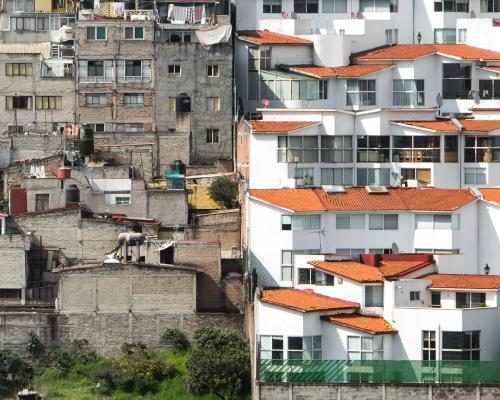
In a stark reflection of wealth inequality, a recent report reveals that the richest 1% of Mexicans control an astonishing 40% of the nation's wealth. This alarming statistic underscores a long-standing issue that has persisted for decades, where a small elite thrives in luxury while millions struggle to meet basic needs.
In the working-class neighborhood of Santa Lucía Reacomodo in Mexico City, the realities of this inequality are palpable. Surrounded by opulent apartment buildings and exclusive gated communities, the area is home to residents like María del Socorro Corona, 79. She recalls the days when Santa Lucía was merely a cactus-covered hillside, years before a bridge was built connecting the bustling business district of Santa Fe. Today, her two-bedroom turquoise home is filled with bags of clothes and trinkets she sells at a local market, emphasizing her determination to survive: "I have to make money," she said, "or I won't eat." Originally reported by The Guardian.
The growing divide has deeply affected the community. As wealth concentration rises, the contrast between affluence and poverty becomes increasingly stark. Viri Ríos, a public policy expert and director of Mexico Decoded, points out that "Mexico is unbelievably unequal - it's almost inconceivable." A recent Oxfam Mexico report highlights this disparity, indicating that nearly 19 million citizens face food insecurity, while the 22 billionaires in the country have seen their fortunes double in just five years, amassing a staggering collective wealth of $219 billion.
Extreme Wealth Concentration
The report reveals that between 1996 and 2025, the wealth of Carlos Slim, Latin America's wealthiest individual, surged more than eight times, with other billionaires seeing their fortunes quadruple. "Over the past 30 years, extreme wealth concentration has become entrenched in Mexico," the report states. "Ultra-rich Mexicans have never been so numerous or so wealthy as they are today." As the rich grow richer, the plight of the poor persists, yet there are signs of improvement.
During the tenure of former President Andrés Manuel López Obrador, substantial increases in the minimum wage contributed to a notable decline in poverty. The number of people living in poverty dropped by 13.4 million, while those in extreme poverty decreased from nearly 9 million to around 7 million. According to the World Inequality Database, inequality in Mexico is at its lowest since 2006, with Ríos noting, "What we're witnessing are historic reductions in Mexico's inequality."
Living Conditions in Santa Lucía Reacomodo
Despite these improvements, the divide between rich and poor remains pronounced. In Santa Lucía Reacomodo, the inhabitants face daily challenges that starkly contrast with the lives of their affluent neighbors. The gated community of Bugamvillas and luxury apartment buildings impose restrictions that isolate the wealthy. Security measures are stringent, with guards denying access to outsiders, creating a physical and social barrier that reinforces the gap. A police presence further underscores the divide, with patrols ensuring the safety of the affluent while the working-class neighborhood grapples with crime.
Residents like Sebastián Cejalugo, a garbage collector who has lived in Santa Lucía all his life, articulate the fears that come with living in such an environment. "After 8 or 9pm you're done for," he said, reflecting on how crime has escalated. Francisco González, another local, laments the changes in the neighborhood: "It used to smell like forest," he noted, "now it smells of cats, dogs, and marijuana." The construction of the bridge nearby has only worsened the situation, introducing a constant hum of traffic along with the noise of sirens from emergency vehicles.
Policy Changes and Future Outlook
While the situation remains challenging, the recent shifts in policy under López Obrador's administration present a glimmer of hope. Efforts to increase wages have made a significant impact, and there's an increasing recognition of the need for reform in labor policies to address income distribution. Ríos asserts, "There are many policies, especially labor policies, that are changing income distribution in the country in ways we haven't seen in decades."
As Mexico grapples with its economic disparities, the contrast between neighborhoods like Santa Lucía Reacomodo and the luxurious enclaves nearby serves as a stark reminder of the work that remains. The road ahead will require sustained effort to bridge the wealth gap and create a more equitable society. The ongoing struggle for better living conditions and economic opportunities continues, as residents strive to overcome the odds.
Originally reported by The Guardian. View original.