
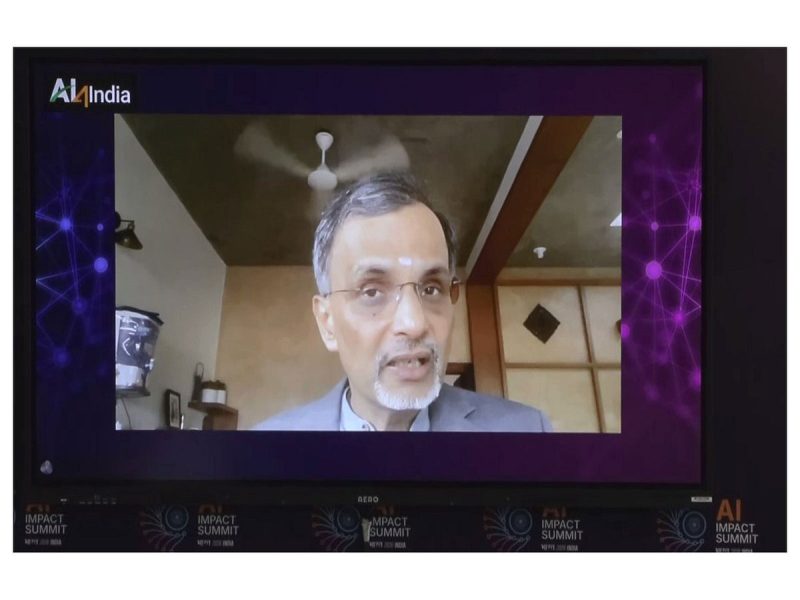
In a compelling address at the AI Impact Summit 2026 in New Delhi, Chief Economic Advisor V Anantha Nageswaran asserted that India's future as a leader in artificial intelligence (AI) hinges on reforming its education system to align technological adoption with mass employability. Nageswaran emphasized that the potential for India to be a pioneer in integrating machine learning with human skills is significant, but it requires coordinated efforts among government, academia, and the private sector.
AI and Human Collaboration: A Vision for India
Nageswaran described a future where machine intelligence and human potential coalesce rather than conflict. He believes that India stands at a unique crossroads, capable of becoming the first large society where AI enhances human capabilities instead of replacing them. "This will not happen by drift; it will require political will, state capacity, and a clear national commitment," he stated. His call for action underscores the urgency of aligning technological advancements with the creation of jobs.
The Chief Economic Advisor's vision is not just about adapting to the future of work but is fundamentally about shaping the country's growth trajectory, promoting social stability, and fostering societal cohesion. He insisted that immediate reforms in education and the development of foundational skills are essential for harnessing the full potential of AI and ensuring widespread employability.
The Role of Education in AI Adoption
Highlighting the necessity for educational reform, Nageswaran argued that India's approach must evolve to better prepare its workforce for an AI-driven economy. He posited that the initial step in this transformation lies in rethinking pedagogical methods and the delivery of essential skills. "The path to co-creating prosperity with AI begins with education," he remarked, urging stakeholders to act swiftly to modernize curricula and enhance teaching methods.
According to Nageswaran, the educational landscape must not only focus on technological competencies but also prioritize critical thinking, creativity, and adaptability-skills that will enable individuals to thrive alongside emerging technologies. He called for an educational framework that empowers students and workers, fostering an environment where human ingenuity can flourish in synergy with AI.
Collaboration Across Sectors
The Chief Economic Advisor stressed that achieving this ambitious vision requires a collective effort-what he referred to as a "Team India" initiative. This involves collaboration among policymakers, the private sector, and academic institutions. Recognizing the importance of each player's role, Nageswaran advocated for a unified approach to address the challenges posed by AI while maximizing its potential benefits.
Vineet Nayyar, the Founder Chairman and CEO of Sampark Foundation, echoed Nageswaran's sentiments, emphasizing the need for the IT industry to focus on generating employment through innovative startups. He pointed out that while established IT companies are profit-driven, the government is taking steps to foster a startup ecosystem that can create jobs on a larger scale.
Data Privacy and Strategic Thinking for AI
As discussions of AI evolve, Nayyar also highlighted the importance of data privacy, cautioning that individuals must be vigilant about how their data is utilized. He noted that while large language models (LLMs) developed internationally may currently outperform Indian models, there is a pressing need for India to engage in strategic thinking to develop its own robust LLM frameworks.
This focus on innovative thinking is paramount for India's ambitions in the AI space. Without a radical shift in strategy, Nayyar warned that the country risks falling behind in the global AI race. He underscored that the existing models, while effective, need to be expanded and improved upon to compete internationally.
As India navigates this complex landscape, the integration of AI into the workforce and society at large presents both challenges and opportunities. The economic landscape is evolving rapidly, and with concerted efforts in education and innovation, India can firmly establish itself as a leader in the AI domain, ensuring a prosperous future for its citizens.
Ultimately, the vision articulated by Nageswaran at the AI Impact Summit is not just about technology; it embodies a holistic approach to growth, emphasizing the need for a synergistic relationship between AI and the workforce. By prioritizing education and fostering collaborative efforts, India can harness the power of AI to create a more inclusive and sustainable economy.