
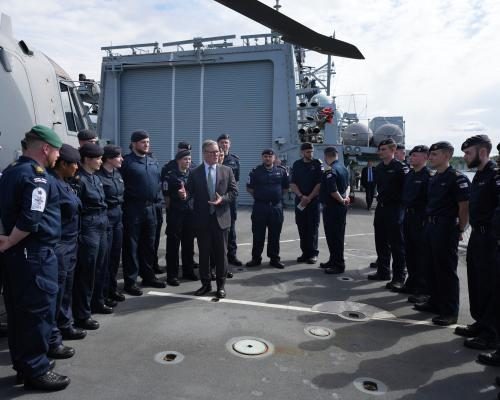
In a stark critique of the UK's military funding, former army chief General Sir Richard Barrons has backed claims made by US Defense Secretary Pete Hegseth regarding the Royal Navy's capabilities. This revelation comes amid ongoing pressure on the Labour government, led by Keir Starmer, to unveil its much-anticipated Defence Investment Plan (DIP).
During a recent session before the Commons liaison committee and his subsequent address to MPs, Starmer faced pointed questions about the timeline for the DIP. This ten-year strategy is crucial for outlining how the government intends to elevate defense spending to 3% of GDP by the end of the next parliamentary term, with an ambitious goal of reaching 5% of GDP by 2035. The defence investment plan was initially expected to be released last autumn, but delays have left critics fuming. Originally reported by The Guardian.
Calls for Urgent Action on Defence Spending
Keir Starmer's inability to provide a definitive timeline for the DIP has sparked frustration among opposition members and defense experts alike. The plan is intended to clarify how the government will meet commitments outlined in last year's strategic defence review, which was spearheaded by Labour peer George Robertson, a former defence secretary and NATO secretary general.
Robertson is expected to address these issues in a speech tonight in Salisbury, where he plans to criticize the Treasury for its handling of military funding. According to reports from Lucy Fisher of the Financial Times, he will accuse "non-military experts in the Treasury" of engaging in "vandalism" regarding the nation's defence capabilities. He will also emphasize the need for a serious national conversation about defence, asserting that Britain is not safe and is underprepared for contemporary threats.
Criticism of Treasury's Focus on Welfare
Highlighting the government's misplaced priorities, Robertson will take aim at Chancellor Rachel Reeves, who only devoted a scant 40 words to defence in her budget speech last year and failed to mention it in her spring statement. "There is a corrosive complacency today in Britain's political leadership," he will assert. "Lip service is paid to the risks, the threats, the bright red signals of danger - but even a promised national conversation about defence can't be started."
Robertson's words carry weight, considering his established position within the political landscape. His long-standing reluctance to stir controversy underscores the seriousness of his current stance. If he feels compelled to speak out, it signals a critical moment for Britain's national security.
Support from Military Leadership
General Sir Richard Barrons, who co-authored the strategic defence review, echoed Robertson's sentiments during an interview on the Today programme. He expressed agreement with Hegseth's remarks, which mocked the Royal Navy's diminished capabilities. Hegseth had previously stated that the UK's naval forces seemed unable to handle significant global challenges, saying, "Last time I checked, there was supposed to be a big, bad Royal Navy that could be prepared to do things like [clear the Strait Of Hormuz] as well."
Reflecting on Hegseth's comments, Barrons admitted, "Like many others I hung my head in sorrow. But I couldn't argue with him because although the Royal Navy and the Royal Air Force and the army are, in their bones, outstanding institutions, they are simply too small and too undernourished to deal with the world that we now live in." This perspective highlights the urgency with which military leaders are viewing the current state of the UK's armed forces.
A Day of Political Engagement
As the political landscape continues to shift, this morning's agenda includes several key meetings. Keir Starmer will chair a cabinet meeting that will feature both political discussions and the usual government proceedings. Other notable events include South East Water executives providing evidence to the environment committee, and education experts discussing special educational needs in the Commons.
Starmer is also expected to meet his Dutch counterpart, Rob Jetten, later today, further emphasizing the importance of international cooperation in security matters. The pressing questions surrounding the UK's defense capabilities and funding persist, with many watching closely to see how the government will respond.
The mounting criticism from military leaders and politicians alike highlights a significant challenge for the current administration. As the UK faces growing threats both domestically and internationally, the need for a comprehensive and actionable Defence Strategy has never been more critical.
Originally reported by The Guardian. View original.