
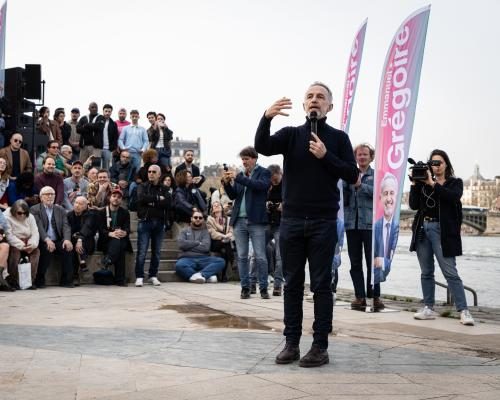
French voters will head to the polls on March 15 and 22 for two rounds of municipal elections that promise to reveal the current political landscape ahead of next year's presidential election. These elections span across 35,000 communes, from small villages to major cities like Paris, Lyon, and Marseille, and serve as a crucial battleground for the far-right National Rally (RN) and its potential alliances.
Significance of the Municipal Elections
The upcoming municipal elections are particularly significant as they are often considered a barometer for national sentiment. With mayors being the most trusted politicians in France, the elections tend to reflect not just local issues but also the broader political climate. Held every six years, this year's elections will be scrutinized closely given the impending presidential race in 2027, which could see a far-right candidate, possibly Jordan Bardella or Marine Le Pen, emerge as a front-runner. Originally reported by The Guardian.
Polls show that while municipal elections usually focus on local governance, they also gauge party support and highlight which themes resonate with voters. The complexities of this electoral system, which allows any candidate list receiving over 10% of the vote in the first round to advance to the second, complicate predictions and invite potential coalitions. This could either help the RN consolidate power or hinder its ambitions.
The Far Right's Position and Ambitions
The RN has been gearing up for these elections as a precursor to the 2027 presidential race, aiming to expand its influence in urban areas. In the last municipal elections of 2020, the RN performed poorly, but its fortunes changed in the subsequent European and parliamentary elections, where it emerged as the largest party in France's National Assembly. Currently, the RN governs around a dozen councils and only one major city, Perpignan, but it hopes to change that.
For this election, the party is fielding a record 650 candidate lists, which includes 33 of its 119 members of parliament. The RN is eyeing key cities like Toulon, which it previously controlled, and sees potential in Nîmes and Marseille, where the RN candidate, Franck Allisio, is neck-and-neck with Socialist mayor Benoît Payan. The party's strategy hinges on forming alliances, particularly in the second round, to maximize its chances of success.
Challenges for Macron's Centrists and the Left
President Emmanuel Macron's Renaissance party is facing its own challenges, controlling few local councils and fielding significantly fewer candidates this time: just seven lists compared to nearly 250 in the 2020 elections. Consequently, Renaissance is looking to form alliances, primarily with the center-right, to maintain a foothold in local governance.
However, one key race to watch is in the port city of Le Havre, where Édouard Philippe, Macron's former prime minister and a prominent centrist figure, is seeking re-election as mayor. His defeat in the second round to a moderate left alliance could have major implications for the 2027 presidential race. The moderate left, which includes the Greens, has weakened since its strong performance in 2020, raising questions about its ability to retain control of cities like Nantes, Montpellier, Lyon, and Strasbourg.
Meanwhile, the far-left party France Unbowed, led by Jean-Luc Mélenchon, is targeting northern towns, including Roubaix and Seine-Saint-Denis. Despite the PS refusing a national alliance with the increasingly divisive Mélenchon, local collaborations may emerge, though tensions remain high. In Marseille, for instance, the radical left candidate Sébastien Delogu has indicated he will not withdraw from the race, which could split the left vote and inadvertently benefit the RN.
The Road Ahead: Potential Alliances and Uncertainties
As the municipal elections approach, the dynamics surrounding the RN and its potential alliances are becoming increasingly complex. With signs that the traditional Republican front, which has historically united against the far right, is fracturing, local politicians are beginning to explore possible collaborations with the RN. This shift could significantly alter the political landscape.
The RN is especially focused on cities in southern France and key urban centers, where it believes it can capitalize on growing discontent with traditional parties. The outcome of these elections will not only affect local governance but could also set the stage for the 2027 presidential race, as parties scramble to define their strategies and alliances in a rapidly evolving political environment. With the stakes so high, both voters and political analysts will be watching closely to see whether the far right can solidify its power or if the traditional parties can effectively rally against it.
Originally reported by The Guardian. View original.