
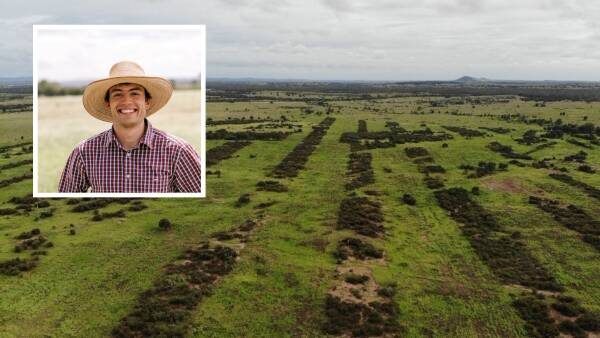
Retaining 20 to 30 percent of brigalow regrowth on grazing lands can enhance pasture productivity while managing costs, according to findings presented at a climate-smart grazing field day in Bauhinia. PhD researcher Brodie Crouch highlighted this during the Building Climate-Smart Grazing Systems event held on February 19, where data from over 20 properties in central Queensland revealed significant insights challenging traditional views on trees and productivity in grazing systems.
Crouch, a doctoral candidate from the University of Queensland, is investigating biodiversity management within brigalow grazing landscapes that stretch from Moura to Augathella. His research focuses on the strategic placement of trees rather than the binary choice of clearing versus preservation. This innovative approach examines how tree distribution impacts pasture growth, cattle grazing patterns, and the resilience of grazing systems over time.
The Benefits of Tree Retention
Properties that maintain between 20 to 30 percent brigalow cover are not only fostering impressive levels of woodland bird diversity but also improving production metrics. Crouch pointed out that this retention level supports over 20 bird species native to the brigalow ecosystem, many of which have seen significant declines due to habitat loss. Additionally, various reptiles and small mammals, reliant on the ground cover provided by brigalow, are also affected.
However, Crouch emphasized that the research findings extend beyond mere conservation. He explained that understanding the role of trees in active grazing systems is crucial. His study employed pasture transects and micro-climate measurements to establish a "gain zone" located on the leeward side of tree lines. This area benefits from reduced wind speeds, which in turn helps maintain soil moisture levels and can lead to increased pasture yields when compared to fully exposed paddocks.
Understanding Grazing Patterns
While it's evident that some production is lost directly beneath trees, Crouch's research is focused on quantifying how much of that loss can be offset by increased productivity elsewhere. To explore how retained trees influence cattle grazing behavior, over 250 GPS collars have been placed on cattle across four properties in the Arcadia Valley and Taroom regions.
Preliminary results indicate that grazing areas equipped with distributed shade, strategically placed shelter belts, and accessible water points encourage more even grazing patterns. This is in stark contrast to systems where cattle tend to concentrate around a single shade source or water supply. Crouch noted, "We are investigating how tree cover affects cattle movement within the landscape, which could lead to better pasture utilization overall."
Revolutionizing Grazing Management
The implications of these findings could be transformative for cattle producers. By integrating tree retention into their grazing management strategies, producers might not only enhance production efficiency but also contribute positively to biodiversity conservation. Crouch's research suggests that if cattle feel comfortable traversing the landscape, they are more likely to graze more evenly across paddocks, rather than overgrazing specific areas. This could result in healthier pastures and potentially improved herd performance.
Moreover, Crouch's research addresses the pressing need for sustainable agricultural practices in light of changing climate conditions. As farmers face increasing pressure to balance productivity with environmental stewardship, these insights into the 20-30 percent brigalow retention could serve as a guiding principle for many. By maintaining certain levels of tree cover, producers can cultivate a more resilient and productive grazing system, ultimately leading to improved bottom lines.
As the agricultural community continues to adapt to evolving environmental challenges, the findings from this research underscore the importance of innovative approaches in grazing management. The potential benefits of balancing tree cover with pasture production are becoming clearer, offering a path forward for both cattle producers and conservationists alike.