
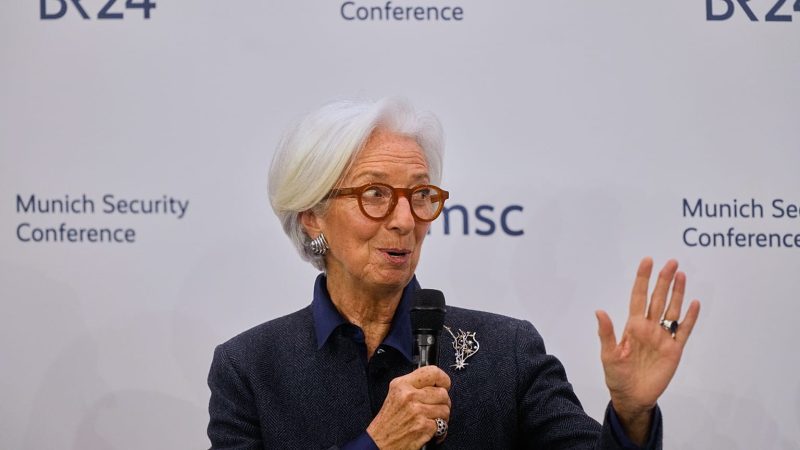
Economists are largely dismissing concerns that a far-right victory in France could significantly influence the European Central Bank's (ECB) leadership or monetary policies. Despite speculation surrounding the potential resignation of ECB President Christine Lagarde, analysts believe any political maneuvering would primarily damage the central bank's esteemed reputation.
Speculation Surrounds Lagarde's Future
Recent reports have ignited discussions about Christine Lagarde's tenure at the ECB, with sources suggesting she might resign before her term ends in 2027. This speculation follows news from the Financial Times that linked her possible departure to the upcoming French presidential elections in April 2027. With current President Emmanuel Macron ineligible for a third term, an early exit for Lagarde could be seen as a strategic move to secure a more favorable ECB leadership in the face of a potentially Eurosceptic government.
An ECB spokesperson has reiterated that no decision regarding Lagarde's future has been made, emphasizing her focus on her current responsibilities. However, the mere suggestion of a politically motivated departure raises eyebrows about the integrity of the ECB's independence.
Political Maneuvering Risks ECB's Reputation
Economists, including Andrew Kenningham, Chief Europe Economist at Capital Economics, have expressed concerns about the implications of political maneuvering within the central bank. Kenningham pointed out that attempts to engineer an early departure for Lagarde would undermine the ECB's reputation as one of the world's most independent central banks. He stated, "It's not a good look for politicians to be trying to engineer an early departure."
While he acknowledged that the timing of Lagarde's potential exit may be influenced by political pressures, he firmly believes that such actions wouldn't translate into direct control over monetary policy. The prevailing sentiment among analysts is that fears regarding the far-right National Rally's (RN) influence over the ECB are exaggerated.
Concerns Over the Rise of the Far-Right
The rise of the far-right National Rally, led by Marine Le Pen and her successor Jordan Bardella, has heightened anxieties in Brussels and Paris. Polls indicate a strong showing for the RN in future elections, prompting concerns about the potential appointment of key EU positions, including the presidency of the ECB. However, Kenningham has downplayed these fears, asserting that they reflect a degree of paranoia rather than a realistic assessment of the situation.
He explained that the ECB president is appointed by the European Council, which comprises representatives from all 27 EU member states. This broader decision-making structure serves as a safeguard against any single nation's political whims, effectively mitigating the risk that a far-right government in France could unilaterally impose a 'maverick' candidate on the central bank.
Safeguards within the ECB's Structure
The ECB's governance framework is designed to ensure that its leadership remains insulated from political fluctuations. Even in a scenario where the RN gained power in France, the appointment of the ECB president would still require consensus among EU member states. Kenningham reassured that this structure significantly diminishes the likelihood of extreme political influence over the central bank's operations.
He reiterated that while there may be political discussions and speculation about timing, such factors do not equate to a loss of independence for the ECB. The institution's longstanding credibility rests on its ability to operate free from direct political interference, which has been essential for maintaining stability within the eurozone.
Looking ahead, the ECB will likely continue to navigate the complex interplay of politics and economics in Europe. As the 2027 presidential elections approach, all eyes will remain on how these developments might unfold, particularly in the context of maintaining the ECB's independence and credibility. The upcoming political dynamics in France will undoubtedly be scrutinized, but for now, it appears that the far-right's influence on the ECB remains limited.