
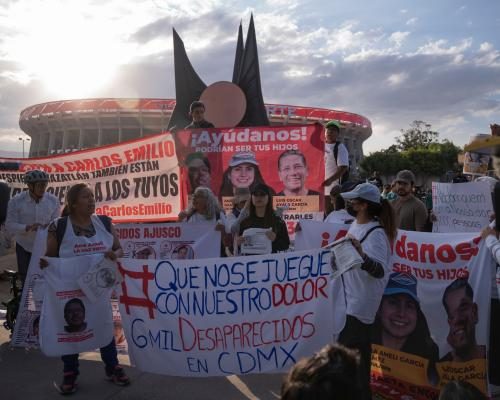
In Mexico, the search for over 130,000 missing persons has taken a desperate turn as families and activists accuse the government of attempting to erase their loved ones from records. With mothers scouring scrublands for clues and social media filled with cries for help, the human rights crisis deepens, fueled by a contentious report from the government.
For over a decade, Mexico has been grappling with an escalating human rights crisis, primarily linked to its ongoing battle against drug cartels. Since the state intensified its war against organized crime, more than 130,000 individuals have reportedly disappeared. Activists and families searching for the missing have long condemned the government's responses as inadequate, but a recent government report has sparked outrage among those who have been tirelessly seeking their loved ones. Originally reported by The Guardian.
Government Report Stokes Outrage
In a controversial new report, Mexican authorities claimed that about one-third of the missing individuals have shown signs of life, while another third were said to lack sufficient data for identification. This assertion has been met with scorn from families who have spent years searching for answers. María Herrera Magdaleno, a prominent activist whose four sons are among the disappeared, expressed her frustration, stating, "What the government is doing is illogical and outrageous. Instead of looking for our disappeared, they're disappearing them."
The government's report indicated that officials cross-referenced registered disappearances with various state records, including tax filings and marriage registries. They concluded that 40,308 individuals-approximately 31% of the total missing-had exhibited activity in state records, suggesting they might still be alive. However, the report also noted that 46,742 cases-about 36% of the total-lacked essential information, making searches nearly impossible.
Activists Challenge Government's Narrative
Activists and human rights organizations have vehemently criticized the government's attempts to minimize the crisis. They argue that the assertion of missing individuals showing signs of life is merely an effort to downplay the severity of the situation. Armando Vargas, a security analyst at the public policy think tank México Evalúa, remarked, "The state is ultimately making the disappeared disappear all over again." He emphasized that this recounting fails to offer justice to victims and ignores recommendations from civil society aimed at addressing the crisis.
In a press briefing, President Claudia Sheinbaum reaffirmed the government's commitment to searching for all missing persons, asserting, "We will continue searching for all missing persons until we find them." Yet, many advocates believe that the current administration's approach is insufficient to tackle the problem effectively. The data revision has drawn comparisons to former President Andrés Manuel López Obrador's claim that only 12,377 individuals were confirmed as missing before the elections, a figure starkly lower than the 113,000 then reported.
The Historical Context of Disappearances
The phenomenon of forced disappearances in Mexico is not new. It traces back to the 1960s and 70s, during the nation's dirty war, when the government targeted activists and dissenters. Many were killed, and their bodies disposed of in mass graves. The issue resurfaced dramatically in 2006 when the government launched its military-led offensive against drug cartels, leading to widespread violence and the systematic use of disappearances as a tactic of terror.
Recent comments from government officials have suggested that the disappearances occurring now are not state-sponsored but rather committed by criminal elements. Marcela Figueroa, a top security official, stated that recent disappearances should not be classified as forced disappearances, as they are perpetrated by individuals, not the state. However, many of the most notorious cases, such as the mass disappearance of 43 students in 2014, have involved state actors, raising questions about the government's responsibility.
Continuing the Fight for Justice
The debate surrounding the missing persons crisis continues to rage, with families and advocates demanding accountability and action from the government. Critics argue that labeling many disappearances as voluntary absences ignores the reality that a majority are victims of violence perpetrated by organized crime. The Centro Prodh human rights group asserted, "Limiting the number of missing persons to 43,128 minimizes the magnitude of a crisis that has a human face."
As the search for the missing persists, families remain resolute, determined to uncover the truth about their loved ones. The fight against enforced disappearances in Mexico is far from over, and advocates continue to demand justice as they navigate a system that often seems indifferent to their plight.
Originally reported by The Guardian. View original.