
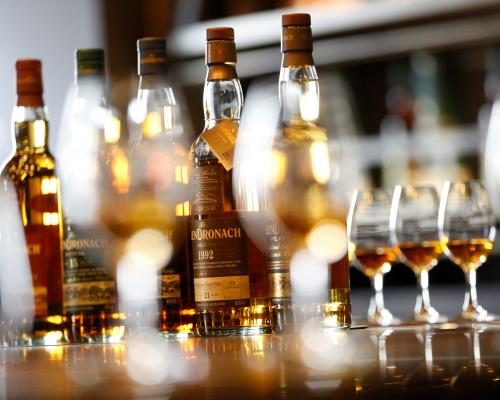
Former U.S. President Donald Trump's recent decision to lift tariffs on Scotch whisky has ignited a fierce political dispute among Scottish party leaders, each eager to claim credit for the announcement. On Thursday, Trump stated via his Truth Social platform that the tariff rollback coincided with the visit of King Charles and Queen Camilla, declaring, "The King and Queen got me to do something nobody else was able to do, without hardly even asking!"
The Scotch Whisky Association (SWA) has welcomed the news, estimating that the 10% tariffs imposed last year cost the industry approximately £150 million in lost sales and resulted in hundreds of job losses. Following the announcement, shares in Diageo, the multinational corporation behind Johnnie Walker, saw a noticeable increase. Graeme Littlejohn, SWA's director of strategy and communications, described the outcome as a "demonstration of the soft power of the monarch and what he can bring to the United Kingdom." He emphasized that it took "months and months of work" to reach this pivotal point. Originally reported by The Guardian.
Political Fallout in Scotland
The tariff reversal has set off a contentious exchange between the Scottish Labour party and John Swinney, the leader of the Scottish National Party (SNP). As the Scottish Parliament election campaign reaches its final stretch, Labour is striving to prevent the SNP from securing a fifth consecutive term. In a heated exchange, Scottish Labour's deputy leader, Jackie Baillie, accused Swinney of being "shameless" for claiming that his meeting with Trump at the White House in September played a crucial role in the tariff decision.
Swinney asserted that Trump was unaware of the tariffs until they met at the president's Aberdeenshire golf course last summer. While visiting a distillery on Friday, he revealed that Trump personally messaged him to acknowledge his influence on the decision. "The president indicates to me in his note the significant influence on his thinking of the Kentucky-Scotland deal, as he puts it," Swinney remarked, referencing the impact of lower whisky sales on Kentucky's bourbon industry.
The UK Government's Role
While Swinney argues for his influential role, UK government officials have been pressing for the tariffs to be lifted since a state banquet for Trump in September. Douglas Alexander, the UK Labour government's cabinet minister for Scotland, contended that trade agreements fall under the purview of the UK government, not Swinney's devolved administration. He dismissed Swinney's claims, stating, "The first minister can hold as many photoshoots and take as many day trips to Washington as he likes - this was delivered after relentless engagement and negotiation with our friends, partners and allies in the United States."
Furthermore, Baillie criticized the SNP for what she described as hypocrisy, pointing out that Stephen Flynn, the SNP's Westminster leader, had previously called for Trump's state visit to be canceled after the president's controversial comments about Ukrainian President Volodymyr Zelenskyy. A former adviser to Swinney had also recently called for an end to the monarchy, adding to the tension between the parties.
The Economic Impact Ahead
The U.S. market represents the largest segment for the Scottish whisky industry, valued at approximately £1 billion ($1.2 billion) annually. The tariffs had a detrimental effect on Scottish whisky producers, who reportedly purchase about £220 million worth of bourbon barrels from Kentucky each year-an essential component for maturing the spirit. Industry experts warn that it may take months or even years for the sector to recover from the losses incurred during the tariff imposition.
One industry insider stated that the tariffs led to a gradual erosion of market share against competing whiskies, which could prove difficult to regain in an increasingly competitive market. The end of tariffs is seen as a critical step in restoring balance and revitalizing the sector.
As the dust settles on this contentious political exchange, the future of the Scotch whisky industry looks cautiously optimistic. With the tariffs lifted, producers now have the opportunity to rebuild and grow their market presence in the U.S., while political leaders in Scotland continue to navigate their claims to credit in a heated election climate.
Originally reported by The Guardian. View original.