
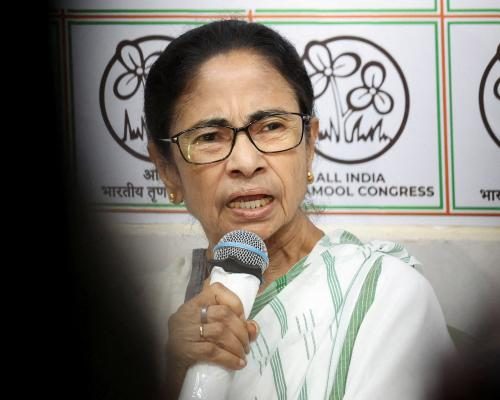
In a dramatic political turn, West Bengal Chief Minister Mamata Banerjee has firmly refused to resign after her Trinamool Congress (TMC) party suffered a significant defeat in the recent state elections. The elections, held on Monday, saw Narendra Modi's Bharatiya Janata Party (BJP) achieve a historic victory, winning 207 out of 294 seats in the West Bengal Assembly. Banerjee, who has led the TMC for 15 years, proclaimed at a press conference on Tuesday night that her party had not lost legitimately, accusing the BJP of manipulating the electoral process.
Mamata Banerjee's Defiance Amidst Electoral Loss
Banerjee, known for her fierce political stance and often referred to as 'Didi' (older sister) by her supporters, expressed her outrage over the election results, declaring, "Why should I step down? We have not lost. The mandate has been looted. Where does the question of resignation arise?" Her comments have stirred controversy and raised questions about the legality of her continued leadership given the TMC's electoral defeat. Originally reported by The Guardian.
With the BJP's victory, the TMC has been reduced to 80 seats, a drastic decline from its previous control. Banerjee's assertion that her party was "defeated not by public mandate but by conspiracy" indicates her determination to challenge the legitimacy of the BJP's win. Under Indian law, she is required to resign, yet she has signaled her intent to remain in office, which could lead to a constitutional crisis in the state.
Political Tensions Escalate with Governor's Warning
The political situation has intensified, with the Governor of West Bengal stating that if Banerjee does not vacate her position voluntarily, police may be dispatched to remove her from office. This declaration highlights the potential for a legal battle, which may escalate to the Supreme Court. The BJP has already taken steps to restrict TMC advisers from entering their offices, further illustrating the growing tensions between the two parties.
Sambit Patra, the BJP's national spokesperson, condemned Banerjee's refusal to resign, labeling it "constitutional blasphemy." In his statement, he emphasized the importance of adhering to democratic norms, arguing that her actions represent an attack on both democracy and the constitution. "What Mamata Banerjee has said and done today is deeply unfortunate," Patra added, underscoring the seriousness of the situation.
BJP's Historic Victory and Its Implications
The BJP's triumph in West Bengal marks a significant milestone for the party, which has aimed to expand its influence in a state long dominated by the TMC. This victory not only consolidates the BJP's control, now governing 21 out of 28 states in India, but also positions it as a formidable force in national politics. The election results signal a potential shift in the political landscape, raising concerns about the future of opposition parties and the nature of governance in India.
Banerjee has accused Prime Minister Modi and Home Minister Amit Shah of "directly interfering" in the electoral process, claiming that the chief of the election commission, appointed by the Modi government, played a pivotal role in undermining the election's integrity. Such accusations reflect her intent to rally opposition forces against what she perceives as an encroachment on democratic principles.
Calls for Opposition Unity Against BJP Dominance
In light of the unfolding crisis, Banerjee has indicated her plans to consult with other opposition leaders to forge a united front against the BJP's perceived authoritarianism. Sanjay Raut, the parliamentary chair of Shiv Sena (UBT), has publicly supported Banerjee's stance, arguing that the election commission has become subservient to the Modi administration. He emphasized the necessity for opposition parties to unite against the "dictatorship of the Centre" and the biased behavior of the election commission.
As Banerjee navigates this challenging political landscape, her refusal to concede power may spark a broader movement among opposition parties, aiming to counter the BJP's growing dominance. The unfolding drama in West Bengal could have significant ramifications not just for the state but for the entire political framework of India.
The situation remains highly fluid as Banerjee's defiance against her electoral loss continues to capture national attention. The coming days will be crucial in determining whether this conflict leads to a constitutional showdown or if a resolution can be reached that upholds democratic principles in the face of adversity.
Originally reported by The Guardian. View original.