
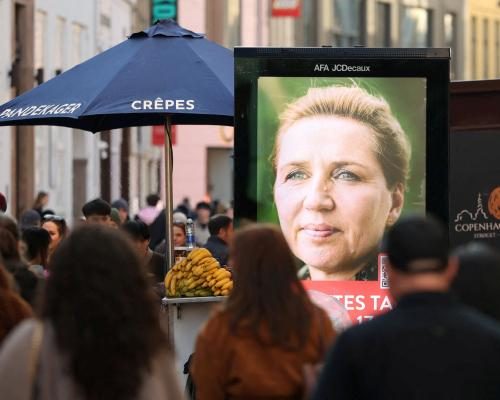
Mette Frederiksen's Social Democrats, leading a coalition of left-leaning parties, have fallen short of securing a parliamentary majority in Denmark's latest election, according to initial exit polls. The election, held on Tuesday amid heightened geopolitical tensions with the United States over Greenland, may signal a shifting political landscape for the country. Although Frederiksen's party appears to have garnered the most votes, their share is estimated at only 19% to 21%, which is below expectations.
Election Results and Political Landscape
As the dust settles from the election, the Social Democrats and their left-leaning allies, collectively known as the "red bloc," are unlikely to achieve the majority needed to form a government in Denmark's 179-seat parliament. On the other side, the right-leaning parties of the "blue bloc" also fell short of a clear mandate. This leaves Lars Løkke Rasmussen, the leader of the non-aligned centre-right Moderates, in a pivotal position as a potential kingmaker. Originally reported by The Guardian.
Official results are anticipated later on Tuesday or early Wednesday, but the early indications suggest that coalition negotiations will dominate the political landscape in the coming weeks. Given the division between the blocs, it seems probable that a centrist or a centre-right coalition will emerge, further complicating Frederiksen's ambitions for a third term as prime minister.
Geopolitical Context and Domestic Issues
The election was conducted against a backdrop of heightened geopolitical tensions, particularly concerning Greenland, a largely autonomous territory of the Danish kingdom. Earlier this year, Frederiksen faced significant pressure from former President Donald Trump, who made controversial remarks about the U.S. potentially acquiring Greenland. Although discussions between the U.S., Nuuk, and Copenhagen continue, the immediate tensions have subsided, but their impact on Danish voters appears to be lasting.
During the campaign, Frederiksen emphasized her government's commitment to national security and integrity, stating, "I know that sometimes I express myself a bit bluntly. But given the times we live in, it is perhaps very good that there are some things that cannot be misunderstood: that Russia should not be allowed to win or that Greenland is not for sale."
Greenlandic Prime Minister Jens-Frederik Nielsen characterized this election as historically significant for the Danish parliament, underscoring the geopolitical stakes involved. "We are in a time where we have a superpower trying to acquire us, take us, control us," Nielsen remarked, highlighting the ongoing tensions in the Arctic region.
Domestic Campaign Issues and Challenges
While international matters grabbed headlines, the election was predominantly centered on domestic challenges facing Denmark. Key issues included the Social Democrats' proposal for a new "wealth tax" aimed at funding smaller class sizes in primary schools and addressing the ongoing cost of living crisis. This proposed tax would impose a 0.5% levy on individual assets exceeding 25 million kroner (approximately £3 million).
The wealth tax was met with mixed reactions. Many on the left welcomed it as a necessary step toward economic equality, while affluent business leaders expressed strong opposition. Henrik Andersen, CEO of wind turbine manufacturer Vestas, criticized the proposal, declaring "enough is enough" and suggesting he might leave the country if implemented. Similarly, Robert Mærsk Uggla, chair of the Maersk board, described the tax as "harmful to Denmark."
Future Prospects for Coalition Talks
As coalition talks loom, Rasmussen's role will be critical in shaping the future government. Just prior to the election, he indicated that he does not aspire to the prime ministership again but is open to serving as the "royal investigator," a position that typically involves facilitating the formation of a new government. Despite his extensive experience, Rasmussen aims to present himself as relatable, sharing anecdotes about his everyday life, such as using hand soap instead of toothpaste when necessary.
With the election results pointing towards a fragmented political landscape, Denmark now faces a period of uncertainty. The potential for new coalitions will dictate not only domestic policies but also the nation's stance on significant geopolitical issues, particularly regarding Greenland and the broader Arctic region.
As coalition negotiations begin, the fate of Mette Frederiksen's leadership hangs in the balance, and the future direction of Danish politics remains to be seen.
Originally reported by The Guardian. View original.