
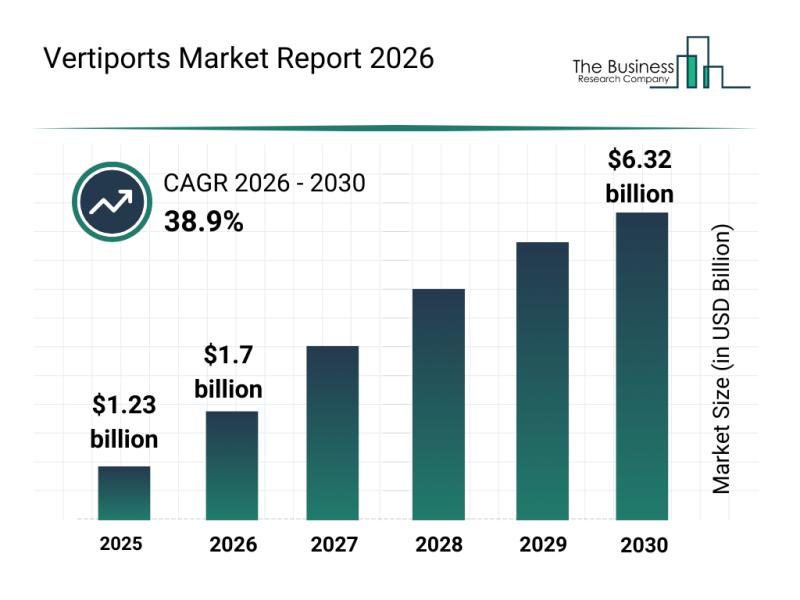
The vertiports market is poised for substantial growth as urban air mobility gains momentum across the globe. With advancements in electric vertical takeoff and landing (eVTOL) technology, the demand for efficient aerial transport solutions is increasing rapidly. The market is projected to expand at a compound annual growth rate (CAGR) of 17.3% from 2023 to 2030, potentially reaching a valuation of $1.5 billion by the end of the forecast period.
Major Players Leading the Charge
As the vertiports market develops, several key companies are emerging as leaders in this burgeoning sector. Firms like Urban Aeronautics, Volocopter, and Lilium are at the forefront, pushing the boundaries of eVTOL technology. Urban Aeronautics has made headlines with its CityHawk aircraft, designed for urban environments and capable of vertical takeoff and landing. Meanwhile, Volocopter is working on its VoloCity air taxi, which aims to be operational in several cities by 2024. Learn more on Investopedia.
These companies are not just innovating in aircraft design; they are also partnering with local governments and private entities to establish vertiports. For instance, Volocopter has partnered with the Frankfurt Airport to develop a vertiport that will serve its air taxi SERVICES. This collaboration reflects a growing recognition of the need for infrastructure that supports urban air mobility.
Emerging Entrants and Investment Trends
Alongside established players, a wave of new entrants is entering the vertiports market, attracted by the potential for high returns. Startups like Skyports and Helipad have recently secured significant funding to develop vertiport infrastructure. Skyports, for example, has raised over $30 million in its latest funding round, which will be used to build vertiports in key urban areas.
Investors are showing keen interest in this segment, with venture capital funding in the eVTOL space reaching $2.5 billion in 2022 alone. This influx of capital is expected to accelerate technological advancements and infrastructure development, making urban air mobility a reality sooner than anticipated. The increasing focus on sustainable transport solutions is also driving investment, as eVTOLs promise to reduce congestion and emissions in urban areas.
Strategic Collaborations and Regulatory Landscape
The success of the vertiports market hinges on strategic collaborations between private companies and government entities. As cities look to integrate eVTOL services, regulatory frameworks must adapt to accommodate this innovative mode of transport. The Federal Aviation Administration (FAA) in the United States is currently drafting regulations for urban air mobility, which will provide guidelines for vertiport operations and safety standards.
Moreover, partnerships between tech firms and infrastructure developers are becoming increasingly common. For example, Archer Aviation has teamed up with United Airlines to develop a network of urban air mobility routes, which includes plans for multiple vertiports. Such alliances are crucial as they facilitate the sharing of knowledge and resources, paving the way for a smoother rollout of vertiport operations.
Global Market Outlook and Future Opportunities
The global vertiports market is not confined to a single region; it is witnessing interest from various parts of the world. Cities in North America, Europe, and Asia are all exploring the potential of urban air mobility. In Asia, countries like Japan and Singapore are leading the charge, with government support for developing vertiport infrastructure and eVTOL services.
Furthermore, the growing urban population and increasing traffic congestion are driving the demand for innovative transport solutions. Analysts predict that as cities become more densely populated, the need for efficient aerial transport will become more pressing. This shift presents myriad opportunities for companies involved in the vertiports market, from construction to technology development.
As the vertiports market evolves, it is clear that urban air mobility is not just a futuristic concept but a forthcoming reality. The convergence of technology, investment, and regulatory support will be pivotal in determining the pace of this transformation.
Originally reported by Openpr.com. View original.