
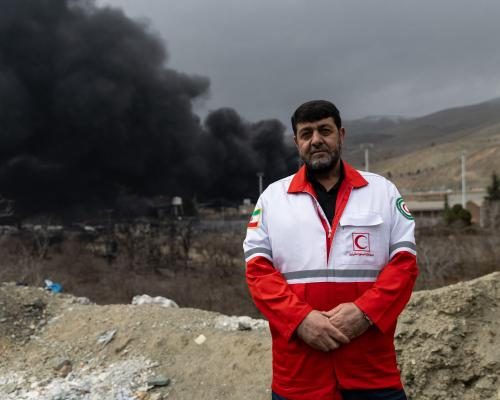
Israel's recent bombings of Iran's oil facilities have ignited serious environmental alarms among experts, who caution that the repercussions could be felt for decades. As the conflict escalates, authorities struggle to monitor the environmental fallout from the ongoing hostilities. The Shahran oil depot located northeast of Tehran and the Shahr-e fuel depot to its south have been ablaze since Israeli warplanes targeted them two days ago.
On Monday, amid nationwide demonstrations in Iran celebrating the appointment of a New Supreme Leader, smoke continued to billow from these sites. The Iranian Red Crescent Society and the country's environmental agency have advised residents to stay indoors, citing concerns about the toxic aftermath of airstrikes on five fossil fuel installations around the capital. Originally reported by The Guardian.
Health Risks from Toxic Fallout
The head of the World Health Organization, Tedros Adhanom Ghebreyesus, expressed grave concerns over the impacts of the bombings. He stated, "Damage to petroleum facilities in Iran risks contaminating food, water and air - hazards that can have severe health impacts especially on children, older people, and people with pre-existing medical conditions."
Iran's Deputy Health Minister, Ali Jafarian, underscored the immediacy of the threat, revealing to Al Jazeera that the soil and water supplies near Tehran were showing signs of contamination following the bombings. Reports of black rain falling across Tehran shortly after the explosions have been confirmed, with Dr. Akshay Deoras, a research scientist at the University of Reading, describing it as a dangerous mixture of soot, particulate matter, and rain from a pre-existing storm.
Immediate and Long-Term Environmental Effects
Dr. Deoras elaborated on the environmental chemistry involved, explaining, "The airstrikes on oil depots released soot, smoke, oil particles, sulphur compounds, and likely heavy metals and inorganic materials from the buildings." He warned that the conditions created by the bombings and subsequent weather could lead to acid rain, compounding the risks associated with inhaling or coming into contact with harmful smoke and particles.
Immediate health impacts have already been reported among Tehran residents, who experienced difficulty breathing, headaches, and irritation of the eyes and throat following the explosions. Professor Andrea Sella, an inorganic chemistry expert at University College London, remarked, "The explosions will have exposed the local population to all manner of undesirable and toxic chemical species, a problem that is well known to accompany warfare." He also noted that the crude oil involved contains various metals, leading to the potential for a serious environmental catastrophe.
Regional Tensions and Escalating Conflict
Amid the turmoil, fears are growing that the conflict could spiral into a cycle of retaliatory strikes. A spokesperson for the Iranian Revolutionary Guards Corps warned of potential responses targeting oil infrastructure in the region, raising concerns among neighboring countries. Bahrain's state-owned energy firm, Bapco Energies, has already declared force majeure on its operations after an Iranian attack on its sole oil refinery.
Additionally, Saudi Arabia has reported intercepting Iranian drones aimed at its Shaybah oil field, further escalating tensions in the region. These incidents follow a series of drone strikes last week targeting key energy installations, including the world's largest natural gas export facility in Qatar and a Saudi refinery at Ras Tanura.
Challenges in Environmental Monitoring
Doug Weir, director of the Conflict and Environment Observatory, highlighted the difficulties of tracking environmental damage amid the ongoing conflict. He noted, "We are now aware of hundreds of environmentally problematic incidents in Iran and the region, but the ongoing conflict, internet restrictions, and delays in the availability of satellite imagery mean that this figure is an understatement."
Efforts to piece together the environmental impact of the war will be monumental, as the complexity of the situation grows with each incident. Weir emphasized, "The war's environmental footprint and its potential impacts on people and ecosystems will be a huge task, and one that grows more complex with every passing day."
The international community watches closely as the situation unfolds, acutely aware of the catastrophic potential of continued violence against vital ecological systems. With the bombings having already caused significant harm, the full extent of the environmental fallout remains to be seen.
Originally reported by The Guardian. View original.