
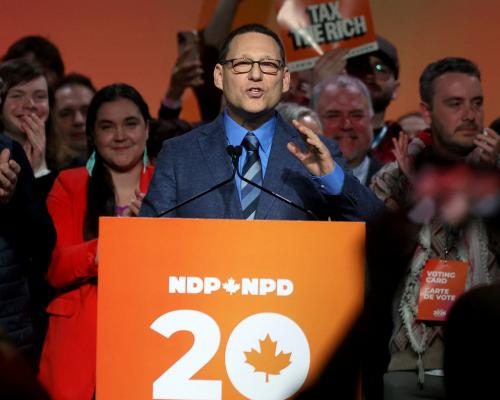
The New Democratic Party (NDP) of Canada has marked a significant turn in its fortunes with the election of Avi Lewis as its new leader. The former broadcaster and outspoken socialist received overwhelming support during a three-day leadership convention, where a record number of party members cast their votes. Lewis's first-ballot victory comes in the wake of a dismal federal election last year that saw the NDP lose its official party status, a challenge he now vows to confront head-on. He declared his ambition to translate the "tremendous momentum" generated at the convention into what he calls an "NDP comeback."
Addressing a lively crowd in Winnipeg, Lewis, 58, emphasized the need for the party to focus on equity and social justice. He outlined a vision that includes higher taxes on the wealthy, investment in green energy, and tuition-free education. "We can already hear the howls from the establishment: 'But how will you pay for all this?'" Lewis said, urging for a fair taxation system for corporations and billionaires who have profited during tough economic times. "It is time, far past time, to properly tax the corporations and billionaires that have been riding a tidal wave of profits while the 99% have been suffering and struggling." Originally reported by The Guardian.
Challenges Ahead for Lewis and the NDP
Despite the enthusiasm surrounding his election, Lewis faces daunting challenges. The NDP currently holds just six seats in Parliament and is grappling with approximately C$13 million in debt. His lack of prior political office experience and absence of a seat in Parliament could complicate his leadership journey. In the leadership race, Lewis triumphed over former MP Heather McPherson, union organizer Rob Ashton, British Columbia city councillor Tanille Johnston, and farmer Tony McQuail. The political landscape has shifted dramatically since the NDP's glory days in 2011, when it captured 103 seats under Jack Layton. Following a loss of 17 seats in the last election, including the resignation of former leader Jagmeet Singh after losing his own riding, the party is now polling at around 6% federally.
Lewis's election comes at a time when the NDP is struggling not just politically but also in terms of its identity. The party's loss of official status earlier this month was worsened by the defection of MP Lori Ildout to the Liberals, leaving the NDP far short of the 12 MPs needed for official recognition. In this precarious context, Lewis's promise of a comeback is a bold declaration, but one that must be backed by a tangible strategy.
Political Landscape and Reactions
The reactions from other political leaders highlight the mixed sentiments surrounding Lewis's win. Prime Minister Mark Carney and Conservative Party leader Pierre Poilievre both congratulated him, indicating a willingness to engage with the newly elected leader. However, both Carney's Liberals and Poilievre's Conservatives have benefited from the NDP's decline, raising questions about the viability of an NDP recovery. Lewis's agenda appears aimed at challenging the status quo, particularly targeting the oil industry and grocery chains that he claims prioritize profit over the welfare of working-class Canadians. "The NDP will start winning again because we will become that beacon to the 99%, illuminating the darkening sky of these terrifying times with the energising light of collective struggle," he asserted.
Support from provincial leaders will be crucial for Lewis. He shared the stage with Manitoba Premier Wab Kinew, whose NDP government recently secured a strong majority. However, some provincial leaders expressed concerns over Lewis's approach. For instance, British Columbia's NDP Premier David Eby acknowledged Lewis's victory but also emphasized the importance of job growth in technology and mining sectors, industries that Lewis has criticized. Alberta's NDP leader, Naheed Nenshi, warned that Lewis's ideological stance could alienate voters in Alberta, particularly given his previous comments against the Alberta NDP government.
Focus on Environmental Policies
One of Lewis's key focuses is enhancing the party's environmental credentials. He has called for a green energy deal and an export tax on oil and gas shipped to the United States, aiming to ensure that Canadian resources are utilized responsibly. Lewis proposes investing 2% of Canada's gross domestic product in combating climate change, a bold initiative that aligns with his vision of social equity and environmental sustainability. The commitment to fight climate change resonates with many younger voters who are increasingly concerned about environmental issues.
As Lewis embarks on this challenging journey, he will need to navigate the complexities of party unity while addressing the diverse interests of its provincial counterparts. His approach to rebuilding the NDP is not only about regaining lost seats but also about re-establishing the party's identity and relevance in today's political climate. The path ahead will require strategic planning and a concerted effort to reconnect with the electorate, especially those who feel abandoned by the current political landscape.
Originally reported by The Guardian. View original.