
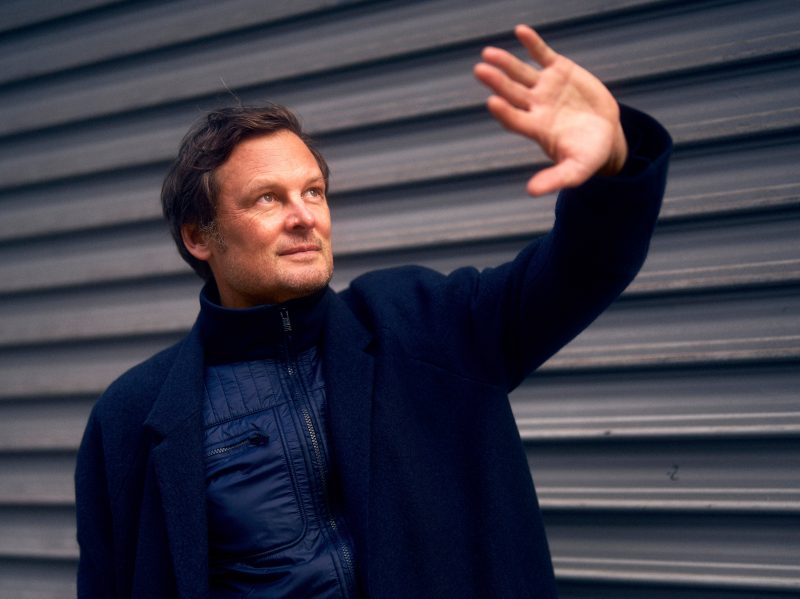
Christophe Galfard, a prominent physicist and science communicator, expresses a bold vision for the future of space exploration and the potential for extraterrestrial life. Known for his mentorship under the late Stephen Hawking, Galfard shared his insights during a recent video interview, emphasizing the vast possibilities that lie beyond Earth. While he believes colonizing Mars remains a distant goal, he is optimistic that humanity may soon discover signs of life in the cosmos.
Life Beyond Earth: A Growing Possibility
Galfard, born in Paris in 1976, has dedicated his career to unraveling the mysteries of the universe. With a background in researching black holes and the origins of the cosmos alongside Hawking, he now aims to bridge the gap between complex scientific concepts and public understanding. "I think there is more life in space than we think," he stated, highlighting the potential for discoveries that could change our understanding of life itself.
His optimism is rooted in recent advancements in technology and astronomy. As telescopes and space missions grow increasingly sophisticated, the search for extraterrestrial life has intensified. The study of exoplanets-planets outside our solar system-has revealed that many could harbor conditions suitable for life. Galfard believes that within the next few decades, humanity may uncover evidence that fundamentally shifts our perspective on life in the universe.
Colonization of Mars: A Long-term Vision
While Galfard is enthusiastic about the prospect of finding extraterrestrial life, he remains cautious about the timeline for colonizing Mars. According to him, establishing a human presence on the Red Planet will take decades of careful planning and technological advancements. He points out that while various missions have been proposed, including crewed trips to Mars, the complexities of sustaining life in such an inhospitable environment are immense.
"We should not underestimate the challenges of sending humans to Mars," he cautioned. Factors such as radiation exposure, resource scarcity, and the psychological effects of isolation must be addressed before any permanent settlement can be established. Galfard emphasizes the importance of incremental steps, starting with robotic missions that can pave the way for future human explorers.
The Nature of the Universe: Questions and Discoveries
During the interview, Galfard tackled profound questions about the universe's origins and existence. When asked about the creation of the universe, he noted the distinction between scientific inquiry and religious beliefs. He affirmed that science has indeed provided insights into the universe's history, revealing that it has a past defined by critical events like the Big Bang.
"The universe we see around us has a story, and if there's a story, there must be a beginning," he explained. However, he acknowledged the limitations of current scientific understanding, particularly regarding what existed before the Big Bang. The mysteries surrounding the universe's origins remain largely untouched, confined to areas beyond the reach of contemporary instruments.
Perspectives on Truth and Belief
Galfard also shared his thoughts on the concept of truth within the scientific framework. He explained that scientific truth is inherently provisional; it evolves with new discoveries and insights. "In science, a truth is never exact," he noted, emphasizing that precision is often accompanied by uncertainties that can lead to new truths emerging from unexpected places.
On a more personal note, he addressed the intersection of science and religion, asserting that his beliefs are private. He respects the diverse perspectives individuals hold regarding spirituality and the universe. This balance between scientific inquiry and personal belief reflects a broader dialogue within the scientific community about the nature of existence.
As Galfard prepares to engage with audiences at the Valladolid Culture Forum and the Telefónica Foundation Space in Madrid, his message resonates with a sense of wonder about the universe. His insights not only inspire curiosity but also encourage a deeper exploration of the cosmos. The potential for discovering life beyond Earth may be closer than we think, igniting hopes for a future where humanity expands its horizons beyond our planet.